Category Archives: Demolition Squad
Stephen Hawking
This week we heard the sad news that Professor Stephen Hawking has died. Media are full of praise for his achievements in his work in cosmology and for his life of survival against all medical odds. Besides his immense scientific reputation, he has achieved a degree of public recognition way beyond other scientists, including appearances in The Big Bang Theory, The Simpsons and Futurama. There was much respect and affection in his public recognition, and an acceptance that because he was so brilliant we must accept his utterances, even if they sometimes strayed far from cosmology – indeed perhaps especially when they strayed, because then there might be a chance to understand what he was saying. All of this is well deserved, and as a physicist I stand in as much respect of him as anybody.
It does a disservice to his achievements, however, if we allow his pronouncements to become a new orthodoxy. He started his career in cosmology by challenging orthodoxy, thinking completely outside the box, and imagining unthinkable new physics. That is exactly how science progresses, and scientists will strenuously challenge his legacy to try to achieve what he, along with Isaac Newton and many other physicists, have attempted but not yet achieved: the unification of all forces into one theory. Scientific theories must always be challenged, extended, replaced and tested if progress is to be made, and the current understanding of Black Holes and the Big Bang are no exception.

Many will have heard his account of the two most valuable lessons he has left for his children:
“Remember to look up at the stars and not down at your feet; and never give up work, work gives you meaning and purpose and life is empty without it.”
While the first lesson is beautiful and a fitting epitaph for this great man, I would question the second lesson. I work really all that life is about? Is the life of a person who cannot work, or cannot find work, meaningless? Isn’t there more meaning in relationships, in love, in beauty, is aspiration, and in human kindness? I recall someone saying that on their deathbed nobody says “I wish I had worked more”, but far more say “I wish I had loved more”. So maybe this is a sad lesson from a man who looked too long at the stars.
Another announcement for which Hawking is famous, in the Grand Design, is that the Big Bang was the inevitable result of the laws of physics, and we do not need to invoke God to trigger the Big Bang. Many may hear this as saying that we do not need God, that the laws of physics explain everything, but that would be to give the statement authority way outside Hawking’s field of expertise. He may well be right that the known laws of physics can produce solutions that look like Big Bangs, but that then begs the question of where those laws of physics come from. Are those laws of physics replacing God? Perhaps rather those laws of physics are God. This is supported by Hawking’s earlier statement in A Brief History of Time, that “If we discover a complete theory, it would be the ultimate triumph of human reason — for then we should know the mind of God.” He also said that “If you like, you can call the laws of science ‘God’, but it wouldn’t be a personal God that you could meet, and ask questions” but he offers no basis for this conclusion about the nature of God, so this is at least open to challenge. Perhaps the laws of physics are one aspect, or incarnation, of God, while other aspects appear in a more personal knowledge of God.
So let us honour a great man who has challenged much and achieved great things, but let us value human lives not for how hard they worked, but for how they aspired and loved and helped others. And let us not understand science of any sort as replacing God, pushing him back into odd corners as a “God of the gaps”, but as part of the endless human endeavour to understand our world, our universe, our very selves as glimpses into the mind of God.

Falls from Grace
Tiger Wood’s tired mug shot appeared in the pages of the newspapers mere hours after his arrest early on the morning of the 29th of May. The overwhelming message to fans and detractors alike was this: Tiger’s return to glory isn’t going well.
Whether you’re a sports fan or not, Tiger Woods meteoric rise in his late teens to his titanic collapse in his late thirties is pure drama. I remember watching Tiger Woods chipping in at the 2005 Masters, fulfilling the eager expectation of the watching crowd. You really could not have written that script. The thought back then was, “if anyone can, Tiger can.”
Tiger was the perfect image of the equation that hard work + natural talent = success. In his case: stunning success. And then it all went wrong. Spectacularly wrong. As news spread that all wasn’t well in his personal life in 2009, first the sponsors fell away and then too the athletic form that propelled him to stardom abandoned him. He went, as the saying goes, from hero to zero.
Tiger’s body, pushed hard for many years, was failing him. There were multiple surgeries attempting to solve this. All the while the world hoped for a revival. Underneath the shell of a broken man, was still a Tiger who stormed the world. He defied convention once, and broke all the rules; surely he could do it again?
But the continued failed and delayed comebacks threatened the great collective optimism of his fans. And then Monday happened. If a picture speaks a thousand words, then Tiger’s arrest photo was a polished closing argument from the sneering opposing counsel.
The media pounced. And the people followed. I felt sorry for Tiger. Reading the report, it didn’t seem fair. I sympathise with Martin Kymer’s words in defence of Tiger:
“I find it so nasty that people just kick him while he’s already on the floor, and at the end of the day it’s just using someone else for your own sadness.”
“”He inspired kids, teenagers; he inspired all of us.”
Idols and Hope
It seems wrong that the same people who ride the wave of euphoria of someone else’ success can then turn on that same person and snub them when they’re low.
It seems two-faced, but I wonder if in fact the two actions are linked. I wonder what the people who watched and applauded the success in awe of the feats of this man were in fact celebrating. Was it the success, or was it the man?
Put it this way, what was the object of their worship?
When we worship (and to find what you worship, start by looking at what you celebrate) people because of what they give us, then when they fail us we feel betrayed. Tiger created the wave, and then the wave crashed upon the beach leaving people emotionally bedraggled.
Ok, so it might now have looked so unkempt on the surface, but ask, ‘what was going on underneath?’ Why is it so hard to praise someone for great feats and then not snarl at them when they fall from greatness?
Surely it would be far healthier to admire the success, decry the failings, but throughout both, respect the person?
But people who are worshipped are not respected. They are demanded to behave in a certain way, and when they don’t they fail more than themselves; they fail us to. And we don’t forgive our fallen idols easily.
Redefining Success and Failure
Another way of seeing this story, and unfortunately the many, many others like it, is to look beyond the immediate. Tiger Woods’ story shows us many things about reality. It shows us the hope of success and triumph, and that is good. And equally it shows us failure, and shame, and they are bad.
Tiger Woods has achieved great success and has known great failure. What then is the status of him? How would you brand Tiger Woods?
But haven’t we all as well each achieved some measure of success and failure? And how do we brand each other? Is the public outcry against Tiger Woods not an echo of the self-indictment we all secretly fear?
Success and failure point beyond themselves to ultimate success and ultimate failure. The Christian knows the freedom of self-judgement that faith in Jesus brings. We aren’t judged on our success or our failures, but on the success of Jesus alone. What the world saw as failure, Jesus Christ on a cross, was the free gift of success to all who believe.
Our heroes in this life will all fail us in some way at some time. So let’s look beyond them to an anchored hope that will never, ever let us down.
Tremendous Evil
It wasn’t until mid-way through Tuesday morning that I learnt of the sad, sad events in Manchester the night before. In my new property, without Internet, phone line, or mobile phone signal, my wife and I were – for a period – cut off from the world.
In my office the next day I was asked, “Did you hear about Manchester?” The tone of the questions signalled the graveness of the situation. “Not again …” was the first thought that came to my mind.
About a decade ago, I was in a plane somewhere over America, reading in the newspaper about a recent shooting at a university campus in the country beneath me. I fought tears as the details of the horrific incident were laid out before me.
These piercing moments, seemingly all-too-frequent, ever closer to ‘home’, arrest our emotions and hold our gaze. How? Why? What could have … ? The questions come thick and fast. The media answers what it can, but then they too join us in pondering the vast unknowns.
The response to the Manchester attack was swift. An out-pouring of emotion, a raised threat level across the country, international voices joining our own leaders in condemning the actions and offering support to the victims.
For the many people caught up immediately in this, the entire furore most likely passes around their heads as part of the chaos that is now their norm in their lives for the moment. The loss, the grief, the sadness … the very real shock of it all will be the overriding theme for them. They need comfort and support now, and across the years to come.
For the rest of us, we mourn too but we mourn differently. Our distance perhaps allows us more reflection. Our ‘How?’ questions might be different to those that lose a loved one, and we might be able to think through the answers a bit more.
Getting Angry
One of the stages of grief is anger. I’ve been there myself in my own life with my own loss. The anger might spill out in awkward ways, like when the supermarket is out of bananas and your face contorts as your mind contemplates a picket line, a march, and a demand for the CEO to resign.
It is right to feel anger when things go wrong; because, things going wrong quite simply isn’t right.
Now on this issue of right and wrong we have, I think, three positions to take. The first is to say that there is no right and wrong, and therefore, yes we might get upset at things, but we can’t really blame anything/anyone. This is a very hard position to take, for various reasons, and a position that really doesn’t seem to fit with the reality of this week.
The other two options both say that there is such a thing as right and wrong, but differ on what the underlying condition of our world is. Are we basically a good world, with some things that go wrong, or are we basically a bad world, with some things that go right?
Yes, it stretches the mind, and the philosophy can seem remote and detached, yet how we answer the fundamental questions directly affects the way we see the world.
Connected with Reality
The shock of the terrible events in Manchester reached so many people. We never expect these things to happen – even as our emergency services train so hard to prepare just in case – but happen they do. The brute facts of this grim reality cannot be denied or evaded to those that look on.
And so we must choose to look on. We must choose to see the world for what it really is. We must ask whether there is such a thing as right and wrong, whether there is some moral standard that defines these terms. Of course, this brings up more questions – if there is such a thing as right and wrong, where does this come from, and how do we know it? etc. etc.
But to deny the exploration because of the complicated follow-on questions, that Heaven forbid might lead us to a question about the existence of God, is to deny the reality of this world and to cease to be a part of the of the remedy that we so clearly need. It’s those who can see a problem clearly that can present clear, hopeful answers.
I could have chosen to live in my new place without calling BT and having an engineer come out and connect us, but I wouldn’t want that. I wouldn’t want the lack of connection to friends and family this would have brought.
So too, I don’t want to live in a world where I am not brave enough to look at the brute realities we face and ask the difficult questions – no matter where they take me – and connect in with each other, and if so led, to the God who may turn out to be at end of all my questions.
Endure the Jostling
When the going gets tough, the tough get going. Or the weak implode. Either way, when life gets bumpy there’s an opportunity to find out what we’re really made of.
A few years ago I took up rowing. I miss those days. The early, frost-bitten starts where training on the river was completed in near total darkness. The gym sessions, the 2k tests … oh the pain! Legs screaming; lungs bursting. OK, so perhaps I don’t miss everything about it.
Yet the camaraderie was unparalleled, and the opportunity to see what exactly I could endure was invaluable. To know that you can be pushed to the limit, and then a little bit more, is powerful self-awareness.
Not every painful lesson in life is presented as neatly as a training session followed by hot coffee and a full breakfast. And not every pain is physical. Not every challenge is chosen and not every moment of agony can be walked away from. We don’t always choose what will test us, and we can’t always choose how we respond. Sometimes life smacks us hard and fast and we’re left reeling.
Our lives when jostled, reveal what’s on the inside. Like a glass of water, when knocked; what’s inside comes out. When placed under duress we reveal who we really are. Our niceties, our politeness – all of which require the usual amount of effort to sustain – don’t come to our aid. They can’t. Simply mustering the energy required when all our mental resources are being otherwise drained is impossible. Our refinement fails us.
For most people, the darkest moments come sparingly; for some they’re all too often. But for all of us there’s an opportunity in each moment of agony to see what’s really going on, deep down. Our modern world might provide the perfect assortment of distractions and diversions, allowing us to hide from ourselves and from others, but these all elude us when we’re jostled hard.
Faced with the fact that most of us in our lives will each be individually rocked to our core at one point or another, we have two options: ignore and hope for the best, or hope for the best and prepare.
Not that we can prepare totally of course. The once-in-a-lifetime flood devastates even the best defences, indiscriminately knocking down valuable and worthless things alike. But we can prepare for the search and rescue. We can reconcile that the things we’ve built will be knocked down, and we can choose today to question what should be rebuilt in its place.
The Beauty of the Church
Wandering around St. Albans Cathedral I marvelled at the beauty of the old, imperial building. The attention to detail, the sheer scope of the ancient project – it was breath-taking. The chance encounter with the orchestra rehearsing Elgar only amplified the moment. I don’t know, perhaps I’m the only one, but sometimes church buildings seem a darn sight more impressive than the people they house.
Choosing a Church today can be a bit of a chore. Modern, convenient transport means we aren’t restricted to the parish church. We can shop around. And so we produce lists; things we’re looking out for. Worship style, child care, service times, outreach projects etc. etc. “Where will be best for me, for my family?”, we muse.
All good questions. The problem is, if that’s all we’re basing our decision on we’re restricting ourselves considerably. Our list of desirables, is just that – ours. It presumes we know our needs, and we know what Church is meant to do for us.
Some of the best services I have been to haven’t been in English. Perhaps there was translation available, or perhaps not. They were so different to my norm that I could more plainly see the beauty in a people coming together for one main reason: to worship a God that they know.
You see, it’s not about the quality of the coffee, or the style of preaching, or the size of the group. The people ultimately come together because no matter who they are they have a greater thing in common.
It makes the true Church the most diverse and inclusive place you will ever find. It’s not about race, or gender, or language, or age, or profession, or location. It’s about someone who transcends all of that: God.
And if I turn up to Church looking to be impressed by the people – better versions of myself, more likely than not – then maybe I will feel comforted and maybe I will feel affirmed in my stylistic choices, but I will forgo the chance to learn something that my personal culture doesn’t let me see.
“The beauty of the Church is that for the most part, it doesn’t look like me.” https://t.co/yJ0w1u10VM
— CVM Demolition Squad (@cvmDemolition) March 3, 2017
Deep down I know that a world full of people like me would be a horror film. Humanity only grows in richness, and collectively reflects more of its Maker, through its diversity. The beauty of the Church is that for the most part, it doesn’t look like me. And that is a very good thing.
Jesus Among Secular Gods: Book Review
Jesus Among Secular Gods is the latest book from Ravi Zacharias and Vince Vitale. Following on from their well-received Why Suffering?, Zacharias and Vitale return to collaborate on a book that speaks strongly to our present age.
Atheism, the belief that there is no God, isn’t new. The writers of the Old Testament certainly spent time arguing for the existence of God, and against the position to the contrary. However today it feels like, in the West at any rate, atheism or secularism – Godless positions of belief – is prevalent, and in many places fast becoming the norm.
Secularism, like belief in God, is really a bit of a catchall position. When we talk about religion, we need to take care to define what God/gods we’re talking about. A cursory glance at the major world religions quite quickly shows that they’re not all taking about the same things. Likewise, secularism is really a group of positions, with a diversity of ideas, values, and priorities. To talk about secularism well, and how it compares to the Christian faith, requires the different categories of thought within the secular worldview to be independently analysed. It’s to this end that Jesus Among Other Gods takes aim, and does so in this reviewer’s mind, pretty well.
Jump down the page to watch the authors talk about Jesus Among Secular Gods
Answers for Questions of Truth
Zacharias and Vitale take turns (2 chapters at a time, for a total of 8 chapters) to outline the breadth of secularism and dive into major areas of thought within, including: scientism, pluralism, humanism, relativism, and hedonism. Without making God the highest good (as in the Christian worldview), the atheist will have to choose some other value as supreme. Whether that’s science (scientism), humanity (humanism) etc. something has to be top priority. Knowing what we celebrate as best is extremely important, as it often goes on to define how we live, what we work towards, what we promote and what we avoid etc.
By comparing the message of Jesus Christ with the alternative positions offered from secularism, the authors seek to offer the reader strong reasons for the supremacy of Christ, over secularism as a whole. By affording different secular positions of thought individual chapters, the book lends itself well as a reference tool to dip in and out of to read about these positions one at a time. However, read as a whole (my preference) the cumulative case for the Christian worldview emerges strongly, equally provoking the unbeliever to re-evaluate their beliefs and at the same time reaffirming and strengthening the faith of the believer. You will find that Jesus Among Secular Gods doesn’t just provide answers to your questions; it provides answers for your friends’ questions and the questions of those half way around the world too.
About the Authors: Ravi Zacharias and Vince Vitale
Zacharias’ experience, garnered over 40 years of tackling the questions posed by secularism, is laid out for the reader to soak up. The wisdom of a life spent listening and then responding to questioners and critics of the Christian faith gives Zacharias a charitable, yet pin-sharp accurate voice of reason in defence of Christianity. He is a clarion voice for our age, and this book reflects his established skill at getting to heart of a matter with truth in love.
Vitale, in my experience (he was my tutor and has become my friend) doesn’t do anything half-heartedly. His reasoning, honed through his academic work in philosophy at Princeton and then Oxford, is coupled with his generosity and this combination presents in an articulate and winsome manner, which is both emotionally and logically satisfying.
Jesus Among Secular Gods is written by authors who have studied at some of the best universities in the world. Yet this book isn’t a book of abstract, philosophical thought, but reflections bourn out of relationships. Zacharias and Vitale both draw heavily on real stories to provide their examples, at once capturing the imagination of the reader and inviting them to relate to the positions laid out. This perhaps is the core strength of the book, in that the style of writing is positively apt; the religion it seeks to defend is itself centred on relationship.
Concluding Thoughts
I enjoyed reading Jesus Among Secular Gods, learning from it and finding much food for thought. In particular, Vince’s chapter on Hedonism was at once haunting and deeply incisive. I am happy to heartily recommend this book, and am sure that I shall be stocking copies to provide to friends with deep questions, and looking for good answers.
Jesus Among Secular Gods is released in the UK on 26th January and is available to buy online from Amazon.co.uk
Disclaimer: I was provided with an advance copy of this book to read, but the review is entirely my own without compensation or incentive.
Vince Vitale and Ravi Zacharias talk about Jesus Among Secular Gods
Goodbye 2016, Hello 2017: Facing the Future Boldly
Sitting here, considering the end of this year, my thoughts turn to what’s next. I wonder, what the biggest headlines of 2017 will be?
In 2016 we’ve seen politics take centre stage, with Brexit and the US Presidential Election the cause of many furious keystrokes from professional pundits to concerned onlookers alike. We’ve watched Syria struggle from afar and, closer to home, we’ve felt the impact of acts of terror in countries not far from ours at all.
We’ve seen a change of Prime Minister, the Queen turn 90, and several beloved celebrities pass away.
For many, 2016 has been a bit of a rollercoaster ride.
Well, this year I spent about a quarter of my time overseas, by odd coincidence mostly on volcanic islands. From the Azores, to Iceland, to Hawaii, opportunities to talk a little bit more about Jesus were coming up. 250 years ago the gospel hadn’t even reached some of these shores. Back then it would take several weeks, by boat, to even get out there. But today, even Hawaii is more or less a day’s journey away.
On this last trip to Hawaii I made a little bit of a pilgrimage to a special spot. My wife and I flew over to the Big Island of Hawaii and hiked down to Kealakekua (KAY-AH-LA-KAY-KOOAAH) Bay to visit a little piece of British land. This was the spot where Captain James cook died in 1779, and later on, a Hawaiian monarch made a gift of the ground to the British, upon which the Royal Navy set up a memorial guarded by downwards-facing cannon.
We faced a steep hike, descending 1500 feet down a cliff, to reach the bay. The only other option would be to do as Cook did, and sail in. It was hot, and the the path was loose under foot.
Reaching the memorial I felt a sort of reverence for the old man. Called by some as the greatest explorer of all time, James Cook, from Yorkshire, sailed into the great unknown and wrote such places at Tahiti, New Zealand, and Hawaii onto Admiralty maps. All from the heaving deck of a ship designed to carry coal around England.

Cook and his crew would cross entire oceans for weeks on end to search out and document strange new lands. Up to one third of his crew could perish on the long voyages. Just reading an account of Cook’s antics (like Horwitz’s) leaves me feeling like a molly-cuddled modern softy, wrapped in luxury and saved from a life of proper hard work.
Cook’s world was no less fragile and the future no less indeterminate back then, I think. The Colonies at that time were revolting, and at the same time struggling with a nasty Smallpox epidemic. Europe was tense and ‘dangerous’ political ideas abounded. The world was not safe. Yet through this all Cook pressed on, through the fear of the world and the fear of the great unknown.
Our world today is tense. We face our own unknowns. As Christians, however, we are fuelled by a life-giving courage that assures of a real Hope in the midst of ever-present despair. As the great institutions of this world are continually shaken, there is an ongoing opportunity for reassessing what we stake our faith in.
2,000 years ago, in the midst of political turmoil, terror, and uncertain futures, one man stared all of it in the face, lovingly, and was in the process killed for it. Politics, terror, fear, greed, religion, opinion … all of humanity poisoned by the base human corruptor, sin. It looked like sin had won, until three days later when bursting to life Jesus Christ rose from death.
To this day billions of people look, as our Queen so eloquently said this Christmas, to “Christ’s example”, a real hope in the midst of real despair.
Whatever your 2016 looked like, and whatever lies before you in 2017, I pray that Jesus’ victory marks your life more than ever, that you live in His joy won by His victory and boldly step forwards in to His future. God bless you.
Stuff
I moved house recently. My wife and I are working overseas for three months, and before we left we packed up everything, sold half, put half in to storage, and left our home.
It’s only when you move that you realise quite how much stuff you’ve managed to accumulate. When looking for a house to rent, a garage was quite appealing to me. Fast forward a few years, and the garage became the bane of my 4-day struggle with our possessions.
Much of what we owned was useful – furniture, kitchen bits, clothes, books (although this is a point of debate) etc. – and I don’t think if you had come to my house you would say that we were living in great luxury, at least in comparison to the people around us.
But nonetheless, this stuff had grown and become a bother. There are a thousand and one things that we can buy to make our lives easier. If you have a TV, then you should have an Apple TV, maybe a Blu-ray player, and surround sound. And books need bookshelves, and the kitchen needs one of those little round things to measure spaghetti portions accurately.
But when we move we suddenly question if the accumulation of stuff in order to make life work a little smoother isn’t just a rouse, perpetuated by kitchen accessory sellers and Swedish furniture companies.
Of course, things are good. Possessions are useful. Yes there probably is a point where enough is enough, but purchased thoughtfully and used appropriately, the inventions and developments of the modern world are entirely good and proper.
I was musing though, as I was boxing up 19 USB cables and hard drives from a decade ago, about what our pursuit of stuff says about our modern culture. We have devices and contraptions to help us cook, help us sleep, help us relax, help us stay connected, and they all do their jobs reasonably well. Very intelligent people create things to help our lives work a bit better, but yet … but yet, we still aren’t eating well, sleeping well, or relaxed – and many of us feel alienated and alone.
Perhaps, then, the stuff that we own says something about a deeper problem that needs to be addressed. If we look past the particular benefits of one device, and we zoom out on our lives, what can we observe? What does it say when the very needs these modern conveniences are meant to address, still persist in the lives of those who purchase them?
More stuff doesn’t seem to be the answer – just ask the very wealthy – and a minimalist life of detachment errs I think too far the opposite way. So, if the physical world doesn’t provide adequate solutions to our felt needs, then instead of grabbing more or eschewing it all, perhaps we ought to ask ourselves if our deepest needs are therefore not physical, but rather spiritual. Because, as any good doctor will tell you, the beginning of the right answer to the problem starts with the correct diagnosis.
Are "most of the teachings of the major world religions the same at their core"?
Our world is more connected today than ever before. People and information move around with greater ease and speed than just a few years ago. With freedom of movement comes freedom of ideas. People, with their ideas, moving from one area to another introduce new ways of thinking, leading to a cross-pollination of philosophies and beliefs.
In Oxford, where I lived until very recently, there are people who believe in no God, or one God, or many God. Some even believe that they are God. It’s most likely a similar situation to where you are.
With the arrival of new ways of thinking, the incumbent philosophies are challenged and sometimes, as a result, modified. Our belief structures are tested. Now, at its core, a belief structure answers the basic questions of life. Questions like: Where have we come from? Where are we going? What in this world has value? What is my purpose?
You of course don’t need to believe in God, or gods, to have a belief structure. Atheists have a belief structure: they believe that there is no God. The way we view the world – our worldview – is shaped by the beliefs that we hold.
The many worldviews on offer, each with their own founders, holy scriptures, and traditions seek to address our world and our problems and provide us with answers. They all have different answers of course. The questions that we face are common to all but the answers are specific to the viewpoint offering them.
For example, the problem posed by the existence of pain and suffering is a universal conundrum; every worldview must address it. “Why does pain exist?” “If there’s a God, why would he/she allow it?” These questions are dealt with throughout history and across cultures.
I once spent some time in the Far East and in my time there I encountered the belief that pain is ultimately an illusion. With this as the diagnosis, is it any wonder that the solutions offered by that worldview centre around becoming aware of the reality of this illusion, and then seeking to escape from it? Likewise, a Muslim may express to you that the suffering of this world is part of the will of Allah. And Allah’s will is set. We see these religious beliefs shaping whole countries and cultures.
With time and repetition beliefs become habits and habits turn into culture. On one holiday to the Outer Hebrides I saw how the islands all but shut down on Sundays to observe the Christian Sabbath. You can’t buy petrol or pop into the supermarket and until recent changes in the last few years, planes and ferries didn’t run on Sundays either. The practices of the people in the Islands changed because of the belief system.
In this way, perhaps we could say that in some respects religion reflects culture. The way people behave – for example the way they dress – becomes a religious belief about how they ought to dress.
Thinking along this line, we might then be inclined to wonder if the differences in the major world religions are merely cultural, the result of distinct people groups forming their identity over many years?
The late Sun Myung Moon from Korea thinks so. He says this:
In 1984, I brought together forty religions scholars, instructing them to compare the teachings that appear in the sacred texts of Christianity, Islam, Buddhism, and other major world religions. The book that resulted from their efforts was World Scripture: A Comparative Anthology of Sacred Texts, published in 1991. What they found was that the sacred texts of religions convey the same or similar teachings more than seventy percent of the time. The remaining thiry percent are teachings that represent unique points of each religion. This means that most of the teachings of the major world religions are the same at their core. The same is true of religious practice. On the surface, some believers wear turbans, some wear prayer beads around their necks, others wear a cross, but they all seek the fundamental truths of the universe, and try to understand the will of the Divine One.
– Sun Myung Moon
Moon isn’t the only one to believe this. It’s quite a popular position today.
A Plurality of Beliefs
We live in a pluralistic society. A plurality of belief structures and moral codes can be found in our world; in your town, your workplace, your pub. Pluralism of course, as a reality, exists. But what about Pluralism as an ideal? Should we equally celebrate the many different approaches to life? Are they all equally valid?

Throughout the history of the world we observe civilisations going to war because of different belief systems. Our united history of the clash of ideas doesn’t paint a pretty picture. ‘Can’t’ we all just get along?’, we might muse, hopefully. Well, historically speaking, no. Peoples have attacked, mocked, and ridiculed others for their beliefs.
Of course, there is a degree in flexibility with all of this. Some ideas we feel happier to hold more lightly than others. But there are plenty of areas that we just won’t bend on. Even the Romans, who absorbed the Greek pantheon of gods, found themselves at odds with the early Christians. Not because the Christians worshipped one man called Jesus as God, but because they worshipped him alone and didn’t recognise Caesar as a deity. At some point every religion, every worldview, claims exclusivity.
The Buddha, for example, was rejecting Hinduism. It was upon the realisation of the amount of pain and suffering that the young Siddhartha Gautama experienced that led him to reject the views he had in search of a better truth. Islam – coming around 500 years after Jesus – claims Judaism and Christianity were useful, but are now invalid and that the Quran is the only holy scripture delivered by the prophet Muhammad.
Many religions agree on so much. They say, for example that it’s good a thing to treat your neighbour well. Showing kindness to friends, strangers – this is a noble thing. And many people from differing religious find they can work together toward common goals such as alleviating poverty. But they differ on some pretty major points. Such as the existence of God or gods, the afterlife, which sacred text is right, how to obtain salvation etc.
For all religions to be true, all paths must lead to the same destination, however, even a cursory glance at the basic tenants of the major religions reveal that they propose some very different ultimate destinations.
Yes, there are some things that multiple religions agree on. And in addition, from the outside, many religions look like the hold the same structure. They might be formed in the same way, but made up of individual distinctions.
For example, many religions operate on the system, ‘If you’re good you’ll be rewarded with eternal bliss.’ All you need to do is lead a good life and you can be assured of a good outcome. But which afterlife are we promised? An eastern extension of self? A cloud in the skies with all our friends? And what exactly are the good deeds that we need to do? Specifically? And now we come to think about it, what exactly do we mean by good?
The more we delve into the complexities of each religion the more we realise that they offer different and distinct final realities with different and distinct paths that we need to follow to reach these realities.
So, what do we do?
What To Believe: 3 Options
When dealing with the plurality of religious beliefs we have I think three options to choose from.
All Religions are true: relativism
Our fist option is to say that all religions are equally true. There are many paths to take but one is not better than the other. It’s up to each one of us to choose which path we will take
To believe this we have to say that all truth is relative. That is, each viewpoint is equally true relative to the person holding it. We would have to reject the idea that absolute truth exists – that is that there are some things that are true for all people in all places.
Of course, relative truth exists. When I visited Nepal I found, to my surprise, that I was a tall man! If I were to be hanging out with my Nepalese friends and said, ‘Hey, I’m quite a tall person’ I would be completely correct – relative to the group.
But then I get on a plane and visit Norway. Now, if I were to make the exact same statement there I would find that I would no longer be saying something that is true. Even if I used exactly the same words and I was exactly the same height.
Because relative truth exists we might be tempted to place religions into this category. After all, if religious belief is relative to the individual holding it, then we can affirm their right to believe it without the need for us to believe it. This can avert conflict and lead to harmony.
It’s a lovey idea and seeks a noble cause. But the problem is that this position is unliveable. And besides, we don’t really live like relativists even if we want to say that is true.
In Oxford there are lots of bikes and I would cycle around a lot because it’s the quickest way around town. And as I cycled around I noticed that I, and the other cyclists always look for that bus, when the cycle lanes and bus lanes converge because we are absolutely sure that if there is a bus and we were to have an accident will always end up worse off.
Think about it, you always (try to) look before you cross the street because even if you believe that you are special and built like the Incredible Hulk, the truth of reality would correct you very quickly.
If we don’t care about whether our lives correspond to reality then we can choose any story for ourselves. But when our story bumps into other stories we face problems.
What we believe defines how we live. Not what we think we believe, but how we really live. Our actions betray our core convictions.
If there was no evil in the world and nothing bad happened to people, if there were no consequences to our actions, then believing in different narratives wouldn’t be an issue. But ideas have consequences.
Furthermore, to state that all truth is relative is of course to make an absolute statement. To categorically state that all truth is relative means that there is no truth which is not relative. If all truth is relative than that very statement must be relative and therefore not necessarily true for all people and people ought not to take us seriously if we say it!
So it emerges that relativism is unliveable. Well then, can’t we just be tolerant of other beliefs? But have you noticed that even tolerant people can’t tolerate the intolerant.
No religions Are True
Our second option is to declare that no religion is true. It was Ernest Hemingway who said that, “All thinking men are atheists.” This statement suggests that when rational enquiry is held all religions fail because they ultimately are irrational. All we need is a little education, a little science, a little knowledge and we’ll see that we have no need for a God.
But is this true? Oxford University is fortunate to some of the brightest minds in their respective academic fields make their home there. People like Professor John Lennox (Mathematics) and Professor Richard Swinburne (Philosophy) have held the chief positions in their fields in a University of international renown and they are committed to belief in God.
They are not alone. Throughout the sciences, the humanities, and the arts there are men and women dually committed to excellence in their field and at the same time publicly professing belief in God.
The atheist Thomas Nagel shows greater humility when he states:
“I want atheism to be true and am made uneasy by the fact that some of the most intelligent and well-informed people I know are religious believers. It isn’t just that I don’t believe in God and naturally hope that I’m right in my belief. It’s that I hope that there is no God! I don’t want there to be a God; I don’t want the universe to be like that.”
We simply can’t write off religion because we don’t want it to be true. We need to investigate. That’s the second point.
One religion is true
The third option we have is to come to the conclusion that one religion, one worldview, is true. After investigation we can come to a belief that one of the many are true and we can put our faith in that.
We all put our faith in something. Faith is simply following the evidence where it leads. The atheist has faith that universe is rational and can be understood through enquiry. You don’t need to be particularly religious to have faith, you just demonstrate a commitment to live out your life in accordance with the views that you hold.
If we reject relativism as unliveable, and if we reject an outright rejection of belief as unfair, then we are only left with an examination of what we believe. The major religions of the world differ enough to be distinct, and require us to do more work than glibly asserting they’re all true, or they’re all false.
We believe for many reasons: cultural, intellectual, emotional … To come to a point of committed, enquired-of faith requires us to examine what we believe and why. This might lead us to reject some of our ideas if they fail to hold up to scrutiny, but that is another matter for another article.
What's Distracting You?
On last year’s Christmas list I mentioned to Santa that I’d like a copy of Focus by Daniel Goleman. 2016 was going to be a year of concentrated effort, where I pick off one task at a time and get things done. Goleman was to be my tutor in single-mindedness.
10 months on and I’ve read Part I (out of VII) and the book sits alongside a dozen or so other books I’ve dipped in and out of. This is no slight on the author – whose Emotional Intelligence is a must-read – it just turns out that I needed Goleman to read Goleman. I am perhaps as some might say, distractible (I prefer to think of this more as allowing my creative processes to be engaged by new ideas.) Jumping from book to book, idea to idea, keeps my mind inspired, sure, but, alas, also distracted. It turns out it’s harder to hit goals when the goalposts are frequently moving.
Current trends indicate that distraction – and especially digital distraction – could soon reach epidemic levels. From social media, to online games, to TV, constant news, and photostreams – our minds don’t ever have to sit still or chew over a single deep idea if we don’t want to. In all this noise it’s easy to become afraid of the silence. Asking questions of ourselves may be painfully hard, if we don’t like the answers, so we turn on and tune out and the big questions remain unexamined. As 16th Century French mathematician Blaise Pascal put it, “All of humanity’s problems stem from man’s inability to sit quietly in a room alone.”
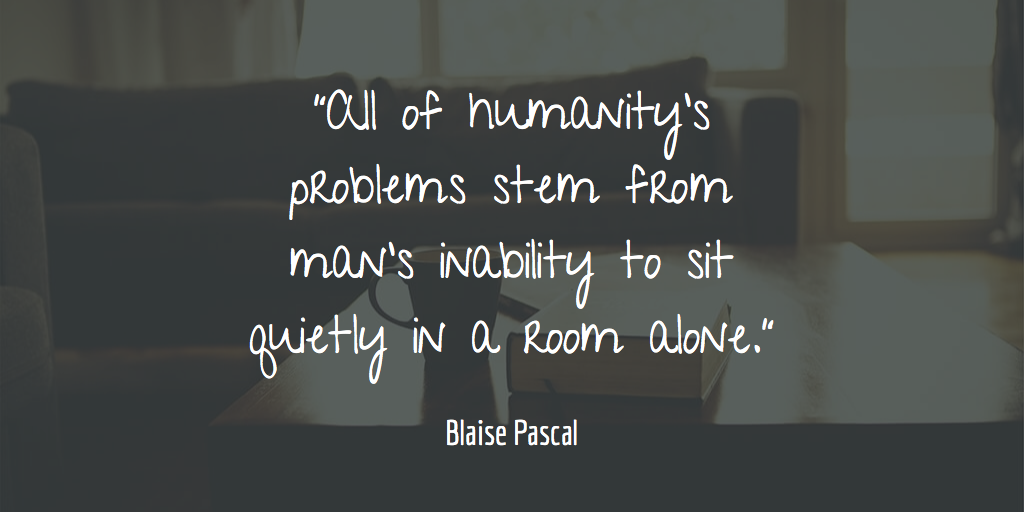
If I’ve had a particularly distracted week I may look forward to the weekend, which affords me the chance to rest my brain, reset, and start afresh on Monday. I have come to learn that distraction, or avoidance, or “multi-tasking”, is incredibly tiring. Facing what we’re dodging, invariably takes less effort than we fear it might, and much less than what we would spend trying to avoid it.
Sometimes what we are manoeuvring around can’t be tackled by a weekend off. When anxiety churns deep within we need a greater comfort than a lie-in, a late lunch, and a few beers. The Bible tells us that real respite for the soul is not for the put-together and perfect people only (if there are any) but for those struggling and tired: Jesus said, “Come to Me, all who are weary and heavy-laden, and I will give you rest.”
If we let multiple distractions run amok in our minds we will weary to the point of exhaustion. We have the technology now to satiate our schemes of avoidance, the motives of which are themselves as old as humanity. So let’s not let distraction abound unchecked, but rather make it our guide, leading us to ask why it is we can’t “sit quietly” and then, turning to God, be led into true rest.
