The Bible – Part II

Have you heard something like this following objection to the reliability of the Bible?
“Well, how do we know that what we have in our hands today is what was written by the authors? How do we know that the text hasn’t been modified to suit the political, theological, and personal aspirations of countless numbers of people throughout the ages?”
In this, the second article of the series, we are examining the history of the transmission of the texts, through the use of the Bibliographical Test.
(Missed part one? Catch up now.)
The Bibliographical Test
When dealing with any book of antiquity, including the Bible, we can subject the texts to scrutiny to examine where and when they came from and how they got into our hands today.
One big question that we would want to know would be, ‘Is the copy of the text that I have now reliable?’ That is, have the words been changed since they were first written down? If the answer is, ‘yes’ – there have been substantial revisions of the text – then we lose credibility of the historical testimony that the Bible offers. We then move from the realm of the Bible being reliable as ‘evidence’ to simply some ‘nice ideas’.
But if the copies that we have today are shown to be accurate to their original manuscripts, then we can say that we have a true representation of what the authors wrote. Of course, you may well say at this point, ‘Well how do we know the authors were telling the truth?’ And that’s a great question. This specific test doesn’t deal with this question, but other tests that we will be looking in Part III do. But first things first, is what we have now what was written then?
To begin with it’s worth comparing the Bible to other famous literary works of history and see how many manuscripts, or copies of the original works, we have.
At this point it’s important to note that we don’t have any of the original autographs. That is, we don’t have, for example, the actual letter St Paul wrote to the Roman church. For that matter, we don’t have any of the originals of the other works we’re mentioning here.
Plato, Caesar, Sophocles, and Homer all wrote various pieces of literature in a similar time-period so let’s look at those.
The Number of Manuscripts
Firstly, let’s establish how many manuscripts we have from history.
- Plato’s Tetralogies: 210 manuscripts
- Julius Caesar’s Gallic Wars: 251 manuscripts
- Sophocles’ Plays: 49 manuscripts
- Homer’s Iliad: 1,757 manuscripts
- The New Testament: 24,633 manuscripts
The vast number of manuscripts of the New Testament is both startling and illuminating. It:
- Shows us how much attention it received by others, and
- Gives us a greater spread of evidence when ascertaining how much change has occurred between the manuscripts.
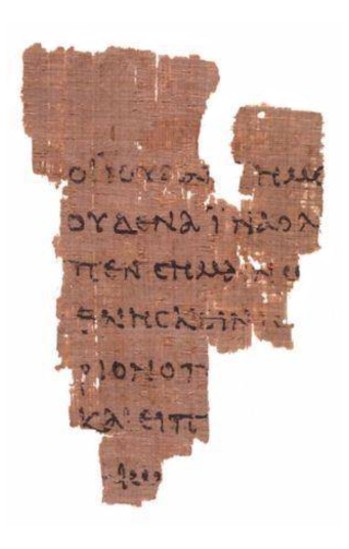
The John Rylands ‘P52’ manuscript (now in the John Rylands Library, Manchester). Discovered in 1920 it shows a portion of John’s Gospel (Chpt. 18 vv. 31-33).
Additionally it is also worth noting that outside of the manuscripts, we have over 36,000 quotes from the New Testament, from the early church fathers, such as Justin Martyr and Origen. Taking just these quotes, we are able to reconstruct the New Testament to within 11 verses of the complete text. We’ll look some more at external sources later in the series.
Taking the 24,633 Greek manuscripts and comparing them one to another over the whole of the New Testament, about 20,000 lines of writing, it has been established that we can observe a 99.6% correlation. What does this show? This is profoundly remarkable as it demonstrates that the copies we have are very, very similar. If there had been many changes, then when the copies were compared there would be significant differences. These just don’t exist in the historical record.
The conclusion we can very reasonable draw is that this evidence shows that the Biblical manuscripts have not been altered since the earliest manuscript that we have. The next point of investigation focuses on how big the gap is between the original work and the first manuscript that we have found.
Time Gap
In comparing the gap between the first manuscript and the date of the original composition of the text, we’ll include some of those other works from history.
- Sophocles lived between 496 and 406 BC. The earliest manuscript we have is from the 3rd Century BC (100-200 years later).
- Plato lived from 427 – 347 BC. The earliest manuscript we have is from 895 AD (1300 years later).
- Scholars date The Gospel of John from the New Testament to the 80s or 90s. The earliest manuscript fragment we have is from approx. 130AD (50 years later).
This short gap between the original and the first manuscript (that we know of – more are being found each year) presents a small historical window for alterations to be made. Crucially, it places any alleged alterations well within the time of the many living eyewitnesses to the events recorded. This is important because it is much easier to fabricate history when all the people who remember what actually happened aren’t around any more to argue about it.
The Dead Sea Scrolls
So far we’ve just looked at the New Testament, so at this point it is worth a short note on the reliability of the Old Testament. For this, the Dead Sea Scrolls find of 1948 is invaluable to us.
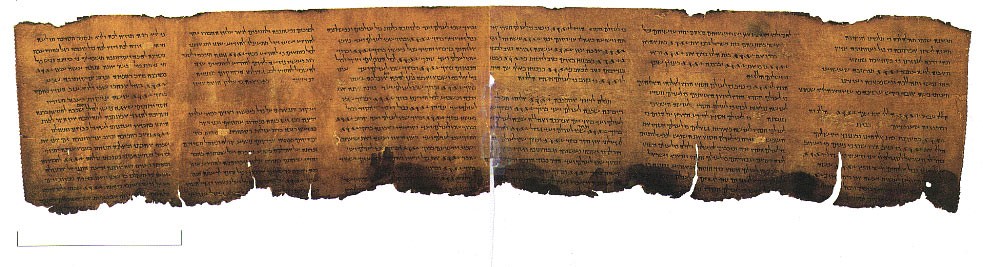
The Psalms Scroll (11Q5) from the Dead Sea Scrolls find.
Prior to the discovery of the Dead Sea Scrolls the earliest manuscripts of the Old Testament were from around 1000AD. When the scrolls were brought out of the caves and examined they were found to have been from 200BC. When these texts were compared to the texts from 1000AD they were found to be virtually identical.
That’s 1200 years of history without any significant changes to the text.
The scrolls contained the entire book of Isaiah along with fragments of every other book of the Old Testament, except the Book of Esther. This find shows that Jews and Christians from 200BC to 1000AD who may well have at some point felt tempted to make alterations to the text for their own gains – particularly when facing the threat of persecution – stayed true to what was written before and left the texts intact, faithfully transmitting them on for future generations.
Assembling the New Testament
To conclude this part of the series, let’s look at the historical record of the complete works of the New Testament.
- The John Rylands manuscript from 130AD has portions of the Gospel of John
- The Bodmer Papyrus II (150-200AD) has most of the Gospel of John
- The Chester Beatty Papyri (200AD) has major portions of the New Testament
- The Diatessaron (160AD) has all four gospels (Matthew, Mark, Luke, and John)
- The Codex Vaticanus (325-350AD) has nearly all of the Bible
- The Codex Sinaiticus (350AD) has all of the New Testament and half of the Old Testament
We have copies of the entire New Testament just 300 years after the first parts were being written with further fragments dating back to within 80 years of the original text.
When we pick up a copy of the New Testament today, we can say with historical authority and conviction, that the words we hold in our hands are overwhelmingly likely to be what the authors originally wrote. They haven’t been changed, deleted, or expanded upon. They are what was written down, they are what the authors intended to communicate.
In Part III of this series we’re going to look at whether we can actually trust the authors. We’re going to ask if eyewitness testimony is credible. And we’re going to look at what other writings from the historical record say about this time. After all, the events surrounding Jerusalem a couple of millennia ago have left a huge mark on history. Surely others must have made note of this? More on that, in Part III.

Thats great research Jonathan,I deal with statistics and the significance of the accuracy cannot be underestimated. This is powerful evidence. I love attention to detail can you let me know which are the 11 verses that haven’t yet been reconstructed?
‘Great research’ but you’ve neglected to mention the Received Text … the only reliable, God-inspired manuscript. You are happy to accept the Vaticanus and Sinaiticus although they are carefully guarded by the Catholic Church which preaches a false gospel supported by these manuscripts and by the the bibles produced from them.
Before you write any more on this subject I would recommend that you look at an alternative view … you must ensure that you’re not perpetuating a dangerous deception. There are countless online articles on this … here are a couple of links to get you started.
http://www.tbsbibles.org/articles
http://www.jesus-is-savior.com/Bible/which_bible_can_we_trust.htm
Hi Voyager,
Thanks for your comment. I included the two codices as they point to an early collation of Biblical documents. In my understanding the Received Text was assembled in the 16th Century (from various Greek manuscripts) and therefore not relevant to my point here.
Thanks for sharing.
Your understanding may be changed by the links provided that I assume you haven’t yet read. This is a very serious issue and you must be sure that you have carefully considered the options before promoting, what many are coming to realise is a counterfeit word of God, prepared by our enemy for these times.
For your own sake and those who read your articles … please read look at the links!
Hi Voyager. I did skim both links when you posted, but I confess I didn’t read both in depth.
I’m not sure I understand the basis of the accusation made against modern translations here. As I understand it, translations such as the ESV make use of the full breadth of early manuscripts with the goal to achieve as accurate a representation of the original autographs.
I don’t know of any conspiracy to pervert the text from the original (which would be a very big problem) but rather the goal is to faithfully represent the original, inspired text.
I appreciate your concern for the safeguard of the Word of God – we’re both on the same page there!
Did you know that the Vaticanus and Sinaiticus texts, which are supposed to be ‘the most reliable texts’ disagree between themselves 3036 times in the gospels alone and that the Sinaiticus was found in a rubbish bin at the Catholic monastery? Are you willing to tell the world that they are reliable and that we can stand on the bibles which are translated from them?
Dear Jonathan, the link below is to a critique of the ESV
which clearly demonstrates that this translation did not achieve its stated
goal ‘to achieve as accurate a representation of the original autographs’.
http://www.tbsbibles.org/pdf_information/139-1.pdf
There was a conspiracy to pervert the text, which I refer to
later, but also a successful attempt by the ‘Fathers of Modern Bible Versions’, Westcott and Hort in the 1880s to re-introduce these perverted texts. These men are known to have been spiritualists and did not believe that the Bible was God’s Word. All modern versions of the bible are based on their text which is in turn is based on the Vaticanus and Sinaiticus. So it seems that we do have ‘a very big
problem’ made more serious by our ignorance/denial of it.
Basically my point is that in your article you failed to mention the text which the early churches of the 2nd and 3rd century as well as the protestant reformers of the 15th, 16th and 17th centuries stood upon and in many cases died for, believing it to be the inspired word of God. Instead you choose to promote the texts which have been influenced by gnostics such as Origen of Alexandria and Augustine for example, which the Church of Rome was built upon and continues to guard closely even to this day.
Modern bibles spawned by these texts reflect much of this gnostic and new age thinking casting doubt on and undermining such things as the virgin birth (Luke 2:33), the deity of Christ (1 Tim 3:16) and the doctrine of the Trinity (1J ohn 5:7)… to quote but 3 out of 1000s of examples.
Incidentally, 1 John 5:7 is the scripture that I use to refute the claims of the Jehovah’s Witnesses on my doorstep that Jesus was a god rather than part of the triune Godhead. Their bible does not say that Jesus is part of the Godhead in 1 John 5, neither does yours and neither do the original texts upon which your bible is based.
One glaring inaccuracy is to be found in Mark 1:2 in your bible and the texts upon which it is based. This is not the case in the AV.
In conclusion, men of God in this day and age need a bible that can be relied on, that can be used to fight off the challenges of the enemy and advance the kingdom. If you, or others in influential positions, continue to promote the Roman Catholic approved texts and their modern versions
then when it is most needed many will find, to their cost, that their main
weapon, the sword of the spirit, is … at best … blunt.
God bless you in your ministry.
Voyager.
Hello?