Author Archives: Alvin Davies
Freddie Spencer – Feel: My Story
Released in April 2017 ‘Feel: My Story’ is the long awaited autobiography of the American motorcycle World Champion ‘Fast Freddie’ Spencer. Freddie’s story is both one of incredible success and struggle. Having burst onto the world stage in the early 1980s Spencer instantly proved to be on, or beyond, the level of Kenny Roberts and Barry Sheene! In 1983, at just 21 years of age, he became the youngest ever to win the 500cc world title (a record only beaten in 2013 by Marc Marquez at 20). Again riding for Honda in 1985, he claimed a further 500cc title. That season he also became the only rider in history to take the 250cc/500cc world titles in the same year – an extraordinary feat that would see him racing in back-to-back events on quite different machines.
‘Feel’ is an engaging, intelligent and well written book. It’s an easy read that gives insight into the mind of a true champion across time. Freddie is open and honest about his childhood, his incredible success on both dirt tracks and road circuits, and about the path his life has taken since. It’s a neatly structured work that swings to-and-from the glory days of the past, the struggles of bodily pain from crashes and the present day as he finds himself reimagining life after a painful divorce and the closure of his business.
Back in the 80s I remember ‘Fast Freddie’ being hailed by Christian journalists as a hero of the faith and Church and yet unsurprisingly he says the press added much. Freddie certainly states that he “always had faith”, and it’s clear that by ‘faith’ he means a real Christian faith, not a cultural faith (he’s from Louisiana). He says that he never went to church as a kid and it becomes evident that it’s his friend Mr Williams, a church-going Baptist who accompanied him to many races, who is the important voice, mentor and friend for Freddie, and his faith. In fact the book is dedicated to Mr Williams as being a man who helped him to know his “purpose in life”. Freddie also talks of reading his Bible regularly too.
While initially the faith element of the book seems infrequent and unintentional (and faith is deeply personal to Spencer), sovereignty and divine guidance slowly unfold as being totally intrinsic to his story. The book revolves around the idea that life can be compared to controlling a race bike. Freddie rode by ‘feel’ (God-given talent, intuition and sensory ability), not by using braking markers and pointers, and so similarly, the message is that we need to exhibit ‘feel’ in life for spiritual guidance.
For Freddie, ‘everything happens for a reason’ (not by chance or fate), and this makes sense of our own journeys through life. He is effectively suggesting that we’ll know which way to turn if we are attuned to the signs – the moments, things and people that happen across our path as we travel (feel). Spencer demonstrates in practical terms by example that divine guidance is available if we respond to these ‘coincidences’ and if we care about who is around us, and why. In addition to this, it is not too strong to say that Freddie embraces and exhibits a repentant turning from the times he has missed those spiritual signals – through being too absorbed in racing, business and ambition. By ‘feel’, rebirth is indeed possible. An inspiring read. Perhaps ‘feel’ equals faith – the certain knowledge of things unseen…
Alvin Davies,
CVM Motorsport
‘You’re the voice,’ Sharing the Saviour. Part 1
Using films, books, culture and sport as we tell others about Jesus.
This is the first part in a series on what it means to share our faith, and therefore what ‘Jesus Saves Racing’ is about at its core. In essence the series will focus on what we as Christians aim to be talking about and how we go about saying it when we share Jesus Christ.
 I love music and enjoy playing guitar and writing songs a bit. Although I have a broad taste in music, ranging from rock to rap and from metal to folk, I would say that primarily I’m most inspired by the singer-songwriter. A guy or gal with a guitar, in a subway, with a message. A voice crying out into my town or city, into my life.
“You’re the voice, try and understand it, make a noise and make it clear… We’re not gonna live in silence, we’re not gonna live in fear…” – John Farnham.
From Woody Guthrie to Dylan and from Tom Petty to Jack Johnson I’m lovin’ the message in the music. The Streets, Arctic Monkeys and Eminem spoke to me because they had something gritty to say. They had observation and a certain critique of our culture. They spoke into a society that they really resonated with. They had a voice with an edge, rather than being a bubblegum-gobbledygook-voice that goes pop. Don’t get me wrong I like pop, but for what it is – surface pop, fizz and bang! But, as a ‘speaker of truth to all mankind’ (as Martin Smith/‘Delirious?’ sang) I want be a voice. I want a message. I want to be Bob Dylan with ‘Blowin’ in the Wind’ and not Aqua with ‘Barbie Girl.’ I don’t want to share ‘plastic life’ with a ‘Barbie world,’ I want to share Jesus Christ with a needy, gritty real world.
Sharing the Saviour
So how do we speak into what is increasingly called a ‘post-Christian’ culture – where references to God are scant and confused? We will be looking at a number of ideas, but this time around we are going to get into what it means to say to someone “you can be saved.” It’s such an important thing to grasp and share.
Recently it was suggested to me that the idea of being ‘saved,’ or someone ‘dying for us,’ is alien to our society… Is it? What do you think? Is that a true statement, or is that just an assumption we’ve been told to believe?
I argued back, “It’s just not an alien idea!”
So let’s tease out this ‘substitution’ thing, this ‘dying for’ saving idea, in our culture (not in our faith, for the moment, we’ll do that later).
“I’m a substitute for another guy” – The Who
Let’s look at a few cultural examples:
‘Dying for us’ is the central thing that speaks to us from those that have laid their lives down for their country (‘They shall not grow old, as we that are left to grow old’). The two minutes’ silence on ‘Remembrance Day’ is a sombre, serious and profound moment when we remember those that died fighting in wars so we can live. We also find many films that have this theme running through them. They range from ‘The Matrix’ to ‘The Way the West Was Won,’ and include movies such as ‘Gran Torino,’ ‘The Guardian,’ ‘Seven Pounds’ and ‘Armageddon’ along the way (with just about every super hero film chucked into the bargain, in some sense).
If we think about songs, we find the concept of dying for someone is the ultimate expression of love, e.g. Bon Jovi – ‘Baby I’d die for you, I’d die for you, I’d cry for you, If it came right down to me and you, You know it’s true, Baby I’d die for you’. We even have a messed up version of ‘dying for’ in Shakespeare’s ‘Romeo and Juliet’ (and thus ‘The Cutting Crewe’s’ song ‘I just died in your arms tonight’ – an ‘80s special!) In sport we have the concept of a ‘substitution’ – the player who takes the place of the tired, the poor performing and the injured.
So we see, ‘dying to save’ is not so alien. In fact it’s very central. The thing that is difficult for us believers to convey is that it is God who is doing the dying for us. Talking about a defined God is increasingly alien (but certainly not extinct) in our ‘post-Christian’ society. Whether you talk of God’s love, God’s existence, faith and science, or being saved by God dying, the challenge is the same – God. (We will return to this difficulty in a couple of blogs time).
“I’m a changing man, built of shifting sands” – Paul Weller
 But there is hope and a way of sharing that message ‘Jesus Saves,’ if we can get to grips with current culture, its history and its mindset.
We do not live in a society with no Christian reference at all. What we live in is a postmodern society that needs to be able to re-link its current ways and attitudes back to their biblical/cultural origins. For, although we lack direct references to the Christian faith (they are a dying breed) we still have the lasting effects of those lost references alive in our culture.
When talking with people we find many Christian concepts and phrases are alive and well, but we do need to do the re-linking work. This gives a wonderful array of illustrations for the Gospel that are easy to grasp and we find we have a lot more to go on than we thought. (It also sometimes mercifully spares us having to tackle some embarrassing so-called ‘Christian’ moments and attitudes from history too… though not always.)
So, we can re-link ‘substitution’ (‘Jesus died in my place’) using films, books, culture and sport as we tell others about Jesus the God/man who died so we might live. We can ask: Why does Remembrance Sunday move us? Is dying for someone the ultimate expression of love? Why does the sacrifice that Bruce Willis makes for his daughter leave us with such admiration in Armageddon? And do we ever feel like that footballer who is ‘played out’ in life and needs someone to step into the breach? – because, as U2 sang, ‘Sometimes You Can’t Make it on Your Own’?
… And that’s another one – ‘stepping into the breach,’ someone who takes the helm from us… and another…
Keep on twanging… keep on singing… ‘You’re the Voice’.
Next blog, more tools for sharing faith in ‘The Main Message’.
Alvin is part of the Jesus Saves Racing Team
Flat out Commitment: God in the Biography
Sometimes as a bit of a break I have to read a biography. I am privileged to be able to spend much of my time researching theology but every now and again I need to drop the intense stuff and read a tale of the sort of courage and against-all-odds endeavour that inspires me. I love a story of outrageous commitment. Of climbing to the top no matter what.
 A friend recently noticed that on my study shelf I had the following books next to each other: ‘The Crucified God’, ‘The Life of Senna’, ‘Villeneuve’, ‘Christ Crucified’ and ‘The Apostolic Preaching of the Cross’. Now there’s some pretty hardcore stuff in there but within the eclectic mix of motor sport and theology there’s a bizarre parallel my friend pointed out. This is the parallel between Christ, the eternal Son of God, dying on the cross and the premature deaths of the racing legends Ayrton Senna and Gilles Villeneuve.
In one sense there is the plain challenge for us concerning how big God is in our lives compared to our sports, passions and work. Is He number one, or do our dreams form idols? My bookshelf could be read a number of ways. But there is also a further way of seeing this challenge that has come home to roost for me over the winter as I have mixed up motor sport and theology – an emulsion of the biography and The Book. This challenge is about our level of commitment to the task of keeping Christ centre stage and of the Good News remaining as our main story.
 As I have read again the lives of Senna and Villeneuve I have seen the utter determination and drive needed to make it to the top. I have seen in their stories a willpower that is so strong that it often flirts with destruction. Senna’s total commitment, for example, kissed goodbye to his marriage when he returned to race in England in 1982, a marriage of only one year. He was also so uncompromising in wheel to wheel combat that he would choose to crash rather than play the championship long-game of accepting second place. In Villeneuve’s case determination meant living in a motor home for a number of years with his wife and two children, often with its frozen pipes bursting in the harsh Canadian winters. It also meant huge financial debt hanging over his family.
This kind of uncompromising desire and commitment of course eventually led to great victories on the track – Senna’s three world championships and his mastery of Monaco, Villeneuve’ ability to drag a car home in first place when it had no right to finish, let alone take the laurels. It is this kind of burning commitment that can re-challenge us. Not to be unbalance and destroy others around us through single mindedness but to tackle head-on our task in hand.

We all have the task of loving our neighbours as ourselves by sharing Jesus with others. This is one of those things that I don’t find as an option in the Bible for the kosher Christian life. We all have unique skills to do this. It’s not just about trying to be the next Billy Graham, the great commission of Matthew’s Gospel (28:16-20) is for all of us, with our unique talents of engagement as the medium. Of course the commission was first given to the eleven apostles, but it’s written down in Matthew for the Church – for us. The question coming to me from the petrol driven preachers of Senna and Villeneuve is this:
“Am I as committed to my task as they were to their tasks…”
…because these guys were committed to their task beyond belief (catch the irony in my drift?) The question is, “am I willing to literally go to the ends of the earth, the ends of myself, the ends of my money, and the ends of my health to tell the world a far greater story than these guys ever had?” They were committed for themselves. How much more should we be committed to and for Christ our saviour, who both made us and died for us?
It seems that often we aren’t willing to take up our cross to the end of our comfort zone let alone the awkward zone, or the down-right painful place. But the Christian life and message is totally, utterly and undeniably cross shaped. Yes, it really can be uncomfortable and rugged, but it is stunningly wild, it is life giving, it is death defying and it is deeply rewarding both in this life and the next.
The ‘biography challenge’ is always a good one for us guys on the Christian road. Next time you pick up a biography dare yourself to ask “Am I as committed to my task as this guy is to his, or do I need to get with the program once again and wake up and smell the coffee?” The great thing is that when we carry our cross, not only do we have the task in hand we also hold the way back to the program. The way back into our own true story. And that story?… well… it’s ‘only’ part of the best biography ever!
Back to the books, I guess… “That will be a double black espresso Sir Barista. Thank you.”
Alvin Davies – Chaplain/Team Manager of Jesus Saves Racing

Back on Track

I keep being told, “The Jesus Saves Racing team are back on track.”
In one sense that’s true. After thirty three years away the team with a message has returned to the track. But was it ever actually ‘off track’?
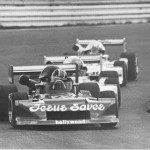 The team officially ran for three years (1978-1980) displaying the ‘iconic’ Jesus Saves logo as the primary ‘sponsor’. It seemed like a quick flourish with historic wins in both Formula Ford and Formula 2, and then, as team founder Alex Ribeiro returned to Brazil, it was gone.
However, Jesus Saves Racing had been over ten years in the making as Ribeiro progressed from Brazilian Formula Ford to F1. From the back streets of Brasilia all the way to Grand Prix racing Alex had faithfully carried the Jesus Saves logo on each of his cars.
As the team discussed its return to the track a burning question sparked in my mind – “am I off track?” We were aware that as a team we had not ‘hit the wall’, the trophies proved it, but when people started using the term ‘back on track’ about us I began to fully embrace this idea more as a concept for me. Sometimes we as Christians can actually be ‘off track’ by simply being parked. And sometimes for years.
In a way it can be easier to deal with life’s big ‘in the wall’ moments than with the ‘car park’. Things happen and the carnage needs sorting. Only too painfully our dramatic crises often reveal our damage. It forces us to step up to the consequences on our knees in front of God and fix the carnage around us. Sometimes we are much like the King David who dramatically repented after the fatal ‘roving eye issue’ (2 Samuel 11; Psalm 51). David hit that wall, and we plainly know when we have too. Many of us also know that like David, through our contrite U-turn and “sorry” God gets us moving again.
But if I’m parked do I really need to do that U-turn?
Revelation 3:15 says that God wants us on fire for him. He wants us hot or cold but not lukewarm. When we sit in the ‘car park’ we might feel like we are happening, but actually we are parked and there is no journey. ‘Parked’ is lukewarm, and ‘parked’ is as much use to both us and God as us being stone cold ‘in the wall’.
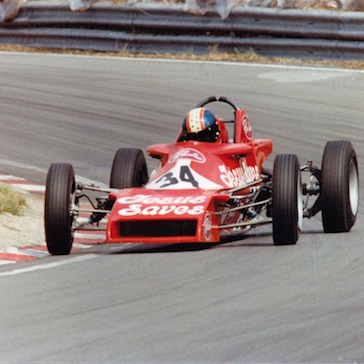 Jesus Saves Racing is rediscovering momentum, there’s lots to do as we return. We are up for it. We, as a race team, certainly aren’t cold or lukewarm but we do find that in our own Christian journeys there’s always a danger of grinding to a halt by us letting life slow us or stop us. In 2013 the Jesus Saves team are moving back out onto the grid. And this is the deal – to do that ‘car park U-turn’ we all need to be rolling …
The challenge for us is to stay hot, whether that means for us a race team or for us all in our daily walk with Jesus Christ. Our moments of being parked are just as dramatic for God as our moments ‘in the wall’, and they need dealing with in exactly the same way. A Christian journey is just that – a journey, it means movement. Sure, respite is a part of the journey but we all know the difference between a vital pit stop and the ‘car park’.
We are never more on fire than when we are right with both God and each other… because we’re moving.
Please get involved with the ‘Jesus Saves’ team this year as together we build vital momentum …
