Author Archives: Nick Welford
The Hat & Tattoo Taboo
 I am a sinner. This much is obvious to me, and probably to regular perusers of this blog, but now it is also obvious to my church. You see the other day I gave a notice in church. Yes that’s right folks, it’s all out in the open now! Did I mention that I did so while wearing a flat cap? And that I wore a short sleeve shirt revealing my small less than one-year old wrist tattoo?
Now I didn’t find out about my sin right away mind you. In fact I didn’t hear directly about it at all. No no no. I found out because somebody was so annoyed that they complained to somebody else, and then that got back to me. The joys of community.
When I left my job in the police I prayed that I would learn to handle conflict in the Christian realm much more effectively. I didn’t feel my police taught methods would be appropriate in the church setting although I certainly gained confidence in the arena of conflict. It appears when you pray to improve your character, you don’t instantly get your wish, but rather plenty of opportunities to practice. So the last two years have involved me having to man up and speak to people face to face more than ever before. But they also involved something else – more of me coming face to face with my own flaws than ever before too – usually by others pointing them out.
This latest episode first angered me, then saddened me with a little bit of perplexity sprinkled throughout. I was first angry at why someone wouldn’t just come and speak to me, then saddened by the same fact before wondering if I wasn’t actually as approachable as I always thought. And if I am to have the privilege of speaking into others lives then I must allow others the same privilege for me whether I think them right or wrong. Especially if I think them wrong.
So I have a plan. If someone tells me I shouldn’t wear my hat in church, or asks how I justify a tattoo, I’m not gonna ask them why none of the women at church wear hats, I am not going to ask them how they have the gall to shave their sideburns. I won’t tell them that they have condemned the innocent because they have not learnt what it means that God desires mercy not sacrifice. I won’t point out that there is a dying world that doesn’t care about hats and tattoos but desperately needs Jesus. Instead I will thank them for their courage in speaking up, and we will go from there. And next week I will get a tattoo…
of a hat on my forehead.
Luke 6:42 (emphasis mine) ‘How can you say to your brother, ‘Brother, let me take the speck out of your eye,’ when you yourself fail to see the plank in your own eye? You hypocrite, first take the plank out of your eye, and then you will see clearly to remove the speck from your brother’s eye.’
Taking a book to a sword fight…
I am cool. There is no doubt about it. If you doubt it you are about to be proved wrong my friend. Very wrong. You see I own an umbrella. Oh yes. Eating your words now aren’t you? But not just any umbrella, you see my umbrella has a handle that is shaped like the handle of a samurai sword! I was giddy with excitement when I ordered it, but this quickly turned to panic when I realised that I might get tasered by the police who would not realise that the brolly was not a sharpened weapon that I was about to unleash on the unsuspecting public. And while in the comfort of my own home I have run around pretending it to be a real sword, out on the streets I use it to protect myself from downpours.
The Bible describes itself as a sword, in fact a double edged sword, yet many Christians use it like an umbrella rather than a sword. We cower under it, misusing and twisting it to protect ourselves from what God wants us to do, rather than letting it equip us to do what He wants us to do. The time we do actually unsheathe the sword we are so untrained with it we usually end up damaging ourselves or other Christians with our wild swipes and swings, and that’s not to mention the Christians who deliberately use it to engage in friendly fire incidents.
A good swordsman is trained, his weapon an extension of his body, his offence and defence a subtle dance of knowledge. He knows when to strike and when to parry. How well trained are you at using the Bible as a sword? Do you know when to attack, and when to defend? Or do you just wave it around willy nilly?
Hebrews 4:12 ‘For the word of God is living and active. Sharper than any double-edged sword, it penetrates even to dividing soul and spirit, joints and marrow; it judges the thoughts and attitudes of the heart.’
Look how accurate a weapon it can be when used properly – soul from spirit, joints from marrow! May you become a good student, not so you just know the Bible, but so that you know how to use it. It’s quite literally a matter of life and death, for you and those around you.
In a strange coincidence Brandon Gilliland has also blogged on similar lines over at Grow Up! You should check it out here.
God, Family, Friends, Church
Ever seen one of those lists, the one where you list your priorities in order. Often for the Christian they look like this:
- God
- Family
- Friends
- Church
- Job
But if we were honest they’d probably look like this:
- Family
- Friends
- Church
- God
- Job
Maybe not exactly but you get the idea. Didn’t Jesus come to free us from this kind of mindless legalism? Have we missed a trick by promoting this kind of priority style list? I mean we all know that God should be number one, but is a list the best way to motivate us? And how does this work out on a day to day basis? Like a to do list? Can we tick off the God part and then move onto our other priorities? Because if that’s the case isn’t it actually our jobs that comes out top? How do we balance God with these other important parts of our lives?
What if instead of making God a part of a list we made him the centre of our lives instead. What if we got rid of the list and instead let God flow into those other areas, if we recognised that God is intricately interested in every minute detail of our lives. If we made God central and placed everything else around Him, would we even need to talk about priorities in the same way? Jesus does say put God at the top of a list. In John 15 he says:
“I am the vine; you are the branches. If you remain in me and I in you, you will bear much fruit; apart from me you can do nothing. If you do not remain in me, you are like a branch that is thrown away and withers; such branches are picked up, thrown into the fire and burned. If you remain in me and my words remain in you, ask whatever you wish, and it will be done for you. This is to my Father’s glory, that you bear much fruit, showing yourselves to be my disciples.”
Out with the list and in with the remaining.
It is not all about Jesus
It struck me the other day that we sing an awful lot about Jesus being everything, that it’s all about Jesus. And let’s face it they are both excellent sentiments but do they tell the whole story? I mean I know we should give our entire heart to Jesus and He should be our main focus, but is it really all about Jesus? Didn’t Jesus Himself say that we needed to love others as much as we love ourselves?
Could it be that in the act of sacrificially loving others we meet and learn to love Jesus on a whole new level? It seems that focusing on Jesus can be an excuse to ignore the plight of our fellow travellers while still convincing ourselves that we are ‘right with God’.
Maybe when we truly live all for Jesus we will find that our love for fellow man increases, but let’s not be naive – it will take some action on our part. If following Jesus doesn’t change the world or at least benefit everyone, including those who don’t believe, then what’s the point? I know we must prioritise Jesus, but if that doesn’t inspire us to love others then perhaps we need to take another look at the Jesus we have prioritised? Maybe this year living for Jesus can mean living for others too?
Matthew 22: 37-39 Jesus replied: “‘Love the Lord your God with all your heart and with all your soul and with all your mind.’ This is the first and greatest commandment. And the second is like it: ‘Love your neighbor as yourself.’ All the Law and the Prophets hang on these two commandments.”
It is all about Jesus
I have never been that good at setting aside regular time to read the Bible and pray. It’s not that I haven’t tried – I have. I have tried when I wake up, when I go to bed, before I eat and so on. Every time the same thing happens, I start off strongly but sooner or later I miss a day. One day becomes two and two becomes three I end up giving up what I have started.
Recently however I have managed half a year of quiet times without ceasing. How have I done this? By realising it is all about Jesus whether I realised it or not. My priority became spending time with Jesus not finding time to spend with Jesus, there is a subtle difference. When I prioritise the relationship rather than the arrangement I find it easier to maintain both. I don’t hold myself to a legalistic schedule, I operate grace and somehow it has worked.
I’m currently reading a book called ‘The God Lab’ by Roger Bretherton and he puts it like this: ‘There was a time in my life when I aimed to carry God through my day. It was an admirable aspiration, I think. I just wanted to remain conscious of him in every moment of the day. But it never quite worked. Within two seconds of arriving at work, I was completely immersed in the demands of the day and barely gave God a thought until lunch, when I realised I’d been spiritually oblivious for hours.
But it started to dawn on me that God’s existence didn’t depend on my concentration. He didn’t disappear in a puff of smoke the moment I thought about something else. Irrespective of my attentiveness to him, God often came running to meet me over the course of the day – an answered prayer, a remarkable conversation, a gesture of kindness, a moment of courage or peace. I began to trust that God was in my day whether I knew it or not.
My premise had been wrong. I didn’t need to carry God through my day. He wasn’t some poor cripple who needed my help to get about. God’s already out there, dancing and weaving and doing his thing. And if I have the eyes to notice him, I can join in.’
Bretherton is right. And similarly it is all about Jesus, whether we recognise it or not.
Colossians 1:15-20 ‘He is the image of the invisible God, the firstborn over all creation. For by him all things were created: things in heaven and on earth, visible and invisible, whether thrones or powers or rulers or authorities; all things were created by him and for him. He is before all things, and in him all things hold together. And he is the head of the body, the church; he is the beginning and the firstborn from among the dead, so that in everything he might have the supremacy. For God was pleased to have all his fullness dwell in him, and through him to reconcile to himself all things, whether things on earth or things in heaven, by making peace through his blood, shed on the cross.’
Proclaiming the Dictionary Incorrect
When I was a lot younger I was convinced that the word chimney had an ‘L’ in it. That’s right I thought the word was pronounced chimley. I’m sure as you say that out loud to yourself you, like me, realise that this is a much more audibly pleasing word. It rolls off the tongue more smoothly than the jarring chimney monstrosity. In fact I can almost hear you joining with me in a chorus of ‘Chim chim-a-ley chim chim-a-ley chim chim charaaaaa….’ Nothing could convince me otherwise. And when, eventually the hardcore word evidence (dictionary) was dragged out to show me the errors of my spelling ways, I obviously proclaimed the dictionary incorrect. I don’t know where I got the idea that chimney was spelt differently or why I argued so hard. I have a theory that a word gnome crept into my bedroom one night whisper the word chimley in my ear then legged it, but that’s only speculation. I now know, after many painful years, I was wrong. My life story is littered with examples like this, where I thought I knew best. Rather than learning this lesson, I seem to be stuck repeating the same mistakes, but sadly on a bigger scale each time.
And so it goes with God, I tell Him how to operate, how to dispense justice, to look on me and mine with favour but turn His back on those I deem unworthy. I ask Him to stand by me, while I walk away from Him, to act in a way that pleases me, while my acts sadden Him. I procrastinate instead of obey, play instead of pray, and judge instead of love. All the while He waits for me, watching, guiding, helping. Taking immense joy in my baby steps towards Him, wishing I would stop dwelling on my failures, my successes, my insecurities and my pride and instead dwell in Him as He dwells in me.
Psalm 103: 2-5 ‘Praise the LORD, my soul, and forget not all his benefits— who forgives all your sins and heals all your diseases, who redeems your life from the pit and crowns you with love and compassion, who satisfies your desires with good things so that your youth is renewed like the eagle’s.’
How do I know God is waiting for me, wanting me to receive His benefits? Because He, as the creator is in the perfect position to know me –
Psalm 103:13-14 ‘As a father has compassion on his children, so the LORD has compassion on those who fear him; for he knows how we are formed, he remembers that we are dust.’
I know because He knows me, how I was made, what I was made from, the weakness blended with Godly strength, the foolishness entwined with true wisdom, the capacity to venomously hate right next to a heart full and waiting to love. Maybe if we didn’t know weakness we would not recognise His strength, without foolishness true wisdom would be the norm, and without hate love would not touch our hearts. I’m glad He knows best – are you?
Autocorrect Theology
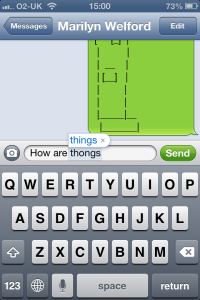 Autocorrect. A modern invention that operates in the background of most devices we type on. Correcting our mistakes and faux pas. We hardly even notice it’s there, until it goes wrong. Then we notice. Then we set up whole websites devoted to sharing the amusement of an autocorrect fail. It’s a bit unfair really isn’t it? You can see how a mostly useful tool can get labelled rubbish. Or how a mostly devoted disciple can get labelled an idiot. Or how a totally loving God can get labelled a bully.
The difference of course is that God doesn’t go wrong, merely our perception of Him. We assume God is like the autocorrect for most of our lives. Always there, working away in the background, correcting our mistakes and making our paths straight, and we barely even notice, or if we do notice we don’t thank Him. Just as we don’t thank the autocorrect for every saved mistake, after all it’s only doing it’s job right?
But then one day it happens, something goes wrong, we experience a level of hurt that we never signed up for when we said yes to God. Our world falls apart and our autocorrect theology has no way of coping, so the blame must lay with God. And so God, as per, gets the bad press. ‘If God is so loving and powerful how could this happen?’ the critics cry ‘He is either unloving or impotent!’ they rally. But when things go well are they asking where God is then? Is the Christian thanking God for making things well? And while this is going on the fulcrum of time remains a man-God dying on a tree.
I don’t know if your life is going well or badly at the moment. I don’t know if the hurts you have experienced are worse than the ones that have befallen me. But I do know that if you cling to that man-God, if you cling to Jesus, through the good times and the bad times, as He clung to the cross for you, then your perspective might just change. You might just catch a glimpse of the true God, who would do anything for His people, and in fact already has.
Job 1:21 “Naked I came from my mother’s womb, and naked I will depart. The Lord gave and the Lord has taken away; may the name of the Lord be praised.”
Potty Training
Did you know that in this day and age you can buy a toilet seat that closes slowly so it doesn’t slam down? That’s right! Instead of risking a toilet seat slam, as it’s known in the trade, you can release the seat at it’s apex, safe in the knowledge that 5-10 seconds later it will gently touch down without a sound. I know because I own one of these marvels of the modern world. Or I did until it broke. That’s right something has happened and now my slow close toilet lid is no more than a common gravity obeying lid.
The thing is I always forget that it’s broken until the very second I have let it go, and as it loudly crashes into the seat I have a moment of frustration at my ever decreasing capacity to remember important things like this. This unique phenomenon doesn’t affect me anywhere else, I am not a habitual toilet seat slammer. I generally assume that other people aren’t as up to date in loo seat technology as I am and place their seats gently down. But my seat was designed to be dropped! It was drop proof! I had become so used to it, that now it is hard to unlearn what I had learnt! It is hard to form a new habit.
As it is with my toilet so it is in life. Forming habits is hard, and is it me or are good habits much harder to form than bad ones? And although I may not have a noisy toilet seat to remind me of every time I fail to stick to a good habit, I do have my backstabbing mind to point out my every fault and failure. Surely there’s a better way? A way to form good habits quickly and effectively?
Matthew 11:29-30 ‘Take my yoke upon you and learn from me, for I am gentle and humble in heart, and you will find rest for your souls. 30 For my yoke is easy and my burden is light.’
The First Man – Pt 2
Last time I wrote about Adam.
The first man.
The blueprint.
The short term man who couldn’t make a stand. But thankfully the story doesn’t end with Adam, it’s just the beginning. God’s plan is for the whole of creation to be restored, to be redeemed. But for that to happen he needs a new Adam, a long term man, whose very life and death are the ultimate stand. One of the Bible contributers, Paul, describes Jesus as the last Adam. Paul sees Jesus as this new Adam, the trueprint. Like Adam, Jesus was to be tempted, unlike Adam, Jesus wouldn’t bow to his own desires.
Just like Adam, Jesus is in a garden. But this isn’t like the garden of Eden, this is not a place of freedom, life and laughter, it’s a garden of death, sword, betrayer’s lips, and savaged ears. Jesus is no fool, he knows what’s coming, that within hours he will be beaten, mocked, humiliated and nailed to a tree, and he is praying – praying so hard that one account tells us that drops of blood fell from his brow. And what is this last Adam, this trueprint praying at the time of his greatest test? He is praying for a way out. Yes you read that right. ”Father this burden is too heavy, it’s too much surely you can’t expect me to? There must be an out, a plan b?” Jesus? Praying for a way out? An escape?
It’s understandable really, he’d spent three years teaching these people how to live a better life, and none of them really got it, not even the ones he was closest too and now, right as he was praying some of them were arming themselves, gathering the local hired thugs to come and force him to his death. And his friends? The ones he needed in his darkest hour? Oh they were catching up on their beauty sleep – know who your mates are? A Carling advert this wasn’t.
It’s very easy to skim over the significance of this prayer, this request for God’s plan to be changed, to think of it as a minor blip in an otherwise perfect life, a slip in the heat of the moment, a quickly uttered mistake even more quickly forgotten. But it is in fact none of these. It is the real and heart felt emotion of a man who loves life and who really doesn’t want to lose his. Jesus repeats this prayer three times. Three times he begs and pleads with God that there be another way. Three times he asks that his life be spared.
But, there’s always a but, that’s not the whole story. You see in order to keep your attention and to draw out the suspense, I have omitted a small but important line from Jesus’ prayer. A line that means this Adam succeeds where the first Adam did not, a line which is long term as opposed to short. A line which takes responsibility, a line which saved your life.
‘Enough about me, Father Your will be done Your way.’
Previously published on Ebs and Flows …
The First Man – Pt 1
I was recently asked to do a five minute talk for a mens breakfast. As I pondered what to talk about I thought about Adam.
The first man.
The blueprint.
But as it turns out Adam didn’t do all that well. The story goes that God made a helper for Adam called Eve. The serpent came to Eve and told her to break the one rule that God had given. You see it wasn’t a hard life in the Garden of Eden, there was only one rule – don’t eat that fruit, the rest is yours.
The snake tells Eve it’s actually ok to eat that fruit and that everything will be better afterwards, and so she does.
Hang on – where’s Adam? Shouldn’t he be looking out for this woman? This helper? This gift from God?
Genisis 3.6 ‘6 When the woman saw that the fruit of the tree was good for food and pleasing to the eye, and also desirable for gaining wisdom, she took some and ate it. She also gave some to her husband, who was with her, and he ate it.’
Adam was right there with her. The whole time. Yet he said nothing. Being a married man myself I can understand that perhaps Adam just wanted to keep the wife happy, he didn’t want to rock the boat, perhaps he didn’t have the energy for a disagreement. He was thinking in the short term.
Adam was there when God gave the one rule, he knew all about it, yet he couldn’t speak up when the time came. Instead he just went with the flow. Imagine if Adam had had the courage to think long term, to do what he knew to be right, even if it meant an argument ensued, even if the short term result wasn’t attractive.
Unfortunately for Adam it gets worse. Having both eaten that fruit, God comes to see what the crack is. He asks Adam first. And Adam basically says to God ‘It was that woman’s fault – and you were the one who put her here!’
Short term thinking is easy, and often instantly gratifying. The world revels in short term thinking, and the current financial climate is an example where this ignorance of the long term leads. By thinking in the short term Adam misses the chance to make a stand for what is right. How often I replicate this in
my own life, feigning ignorance or misunderstanding to avoid making that stand.
I’m sick of that kind of life. It’s time for a change.
Previously published on Ebs and Flows …
