Author Archives: Michael Cooper

Never Give Up
Human endeavour, the quest to be the first to achieve something is a fascinating subject. Throughout history men and women have pushed and smashed through boundaries, for example 12 years ago in September we saw the first successful human powered circumnavigation of the world.
Jason Lewis from Dorset set out on his journey on 12th July 1994, from Greenwich. The expedition of over 46,000 miles, that Lewis thought would take 2-3years, took him over 13 years (4,833 days to be precise). Throughout, Lewis used only human-powered modes of transportation; on foot, by bicycle, roller blades, and a pedal powered boat.
Continue reading
Risk Averse or Risk Taker?
Some years ago, I earned a living in the Business Continuity (BC) industry, perhaps more commonly referred to in the early days as Disaster Recovery (DR). In fact, the emphasis initially was on how businesses would recover from an unplanned outage (disaster). This meant that DR was a set of policies and procedures to enable the recoveryof a business’s critical technology, infrastructure and systems.
Whilst DR remains a relevant and practiced element of an organisation’s business strategy, the approach swiftly developed into one of complete resilience. Consequently, at its heart BC plans, prepares and coordinates activities such that an organisation’s key business functions continue to operate in the event of a serious incident or disaster. In many sectors, incorporation of a proven BC strategy is mandatory; for an ever-decreasing number of others it remains advisory. For those that opt not to include BC as part of the business’s policy it normally comes down to the appetite for risk. (Hope you are following all this .. Ed)
Continue reading
Getting Distracted
I grew up a massive fan of the comedy duo Laurel and Hardy. When most of my mates were into ‘Morecambe and Wise’, the Two Ronnies or Little and Large, I would be watching and laughing out loud as Stan and Ollie got themselves into one ‘fine mess’ after another.
Created at a time where smashing stuff up, public brawling and men wearing knitted socks and full-length gowns in bed was all the rage, their films went on to be compulsive viewing for our children as soon as they could open their eyes and focus. The years of dedication in this vital area of parenting has meant that when the family gather, we’re never far from another viewing of one of Hal Roach’s famous productions. One such occasion happened just the other evening, after a day spent contemplating a huge garage bill to keep the family car on the road. Our youngest son James could see I was a little preoccupied and suggested we put a film on. Randomly we chose a classic (for me, most of them fall into that category). Me and My Pal tells the story of Oliver’s wedding to oil baron Peter Cucumber’s daughter. You can appreciate why she might’ve been quite eager to marry with a surname like that! Anyway, while waiting for the taxi to take them to the ceremony, Oliver and his best man Stanley become absorbed in a jigsaw puzzle, Stanley’s wedding present to Oli. Eventually the taxi driver, the butler, a policeman and a messenger boy all get involved with the puzzle, while Cucumber fumes as he awaits the long overdue groom.
Continue reading
What can I do?
It’s been quite a week just gone. It started with a visit to an ageing relative suffering with Dementia; I’ll call him Winston, because that’s close enough. Winston is 86, was widowed last year, has all his own teeth and physically is in pretty good shape. As is typical of someone with his condition, Winston is great when talking about anything that happened a long time ago, but not so good with recent stuff. Each time I visit we run through the same ‘introductory’ Q&A, but the one thing Winston always wants to talk about is “this God you believe in”. He’s not a Christian, although a man of great integrity. Winston can be quite cynical, but most of all I get the sense he really wants to believe.
Continue readingPrayer
Sign up for the ultimate connection!
For quite some time, 8am on a Sunday morning in our house has become a special time. Not much gets in the way of the whole family gathering around a computer screen to catch up with my Mum in New Zealand.
Despite this being a familiar activity, I’m always amazed by the technology that allows us to spend time together; to see live what’s happening on the other side of the world. Not only do we chat, but often we’ll take the laptop outside to look at how the garden is doing, play ‘hide and seek’ with Niko the dog, as we move away from the screen and back again. From 12,000 miles away Mum will help her grandchildren with their homework. We’ve cooked together, ‘attended’ each other’s parties, read and listened to stories and loads more. And all for free!
This year marks the 142nd anniversary of the establishment of a direct telegraph link between Britain and New Zealand. Imagine then, a Victorian family of four, huddled around the ‘iPomegranate 6S telegraph machine’, eager to tap out a message to their loved ones in the furthest outpost of the British Empire.
As we look further back, history records the numerous challenges and frustrations of long distance communications. Letters and messages taking days, weeks, even months to arrive at their destination. With many never getting there at all!
In the Bible we can read of some unusual ways in which God communicated with His people; sometimes via angels, other times through dreams. In the book of Daniel a hand appears and writes on a wall at Belshazzar’s feast. We see God moving as pillars of cloud and fire to guide the Israelites on a journey. He even spoke through the mouth of a donkey in the story of Balaam.
Yet over all of that time, as today, there has been one form of communication that is always available, always immediate, has infinite bandwidth and costs us nothing. Even more staggering than the miracle of Skype is knowing that the moment we turn our voice and heart to God in prayer He hears our voice. An optical fibre cable may carry thousands of voices, but God hears billions of people simultaneously and answers them all.
Think about that. We can actually talk directly with God, the creator of the universe – creator of you and me. Not only that, He listens and answers. It really is an awesome thing, whether you’re a lifetime pray-er or just starting out. There is real power in prayer, life changing and life sustaining power. Archbishop Justin Welby said this: “In prayer God invites us to be His partners in the transformation of the world through transformed lives”. (‘Thy Kingdom Come’ – Jan 18)
So, if you’re not already doing so, how about making prayer, communication with God, as natural and desirable as the other things you do every day? There are loads of fantastic resources available to help you get started. CVM has produced a great little book called ‘Man Prayer Manual: How, When, Why?’, by Carl Beech, which offers honest, practical and inspirational advice. If you’re a seasoned pray-er, perhaps you could encourage someone else to start praying and offer to support them in that journey.
Wherever you are, the delight my family experiences for 45 minutes every Sunday morning is tiny compared to the joy each one of us can have in a lifestyle of communicating with God through prayer; committing each day to Him, seeking His will for our lives, hearing His voice and sharing with Him in everything we do.

Image Credit: Fré Sonneveld.
Darkest Hour (PG)
Darkest Hour tells the story of Winston Churchill’s first few weeks as Prime Minister in the spring of 1940. Hitler has just invaded France and Belgium, and is heading for an unexpectedly complete and swift victory. All the indications point to what would become the nation’s darkest hour, not only of the time, but in its history.
The Allied army is surrounded at Dunkirk with the British Navy unable to evacuate them. Attempts to persuade the French that the Nazi army could be pushed back, even defeated, are seen as delusional. The consensus, with the exception of Churchill’s assertion, is that the military situation is dire. If, as appears the case, the troops cannot be evacuated over the Channel, the Allies will lose almost its entire army to prisoners of war, at best.
Churchill comes under increasing pressure from his political opponents, as well as allies, to initiate peace discussions with Germany. However, he considers this to be tantamount to surrender, or at the very least, collaboration with the Nazis. Chamberlain and Halifax are arguing in favour of appeasement as being the best outcome they could hope for. They stress that it is simply wishful thinking to hold out for anything better. It is during these heated exchanges that Gary Oldman (playing Churchill) delivers one of my favourite lines in the film; the character is reflecting on his decision to put together a war cabinet of ‘contrasting’ views. In exasperation, he bangs his fist on the table:
“Gentlemen, I purposefully surrounded myself with a range of opinions, it seems I grossly over did it with those that oppose me”.
The drama continues and, as we now know, despite massive opposition, Churchill’s passionate advocacy won over Parliament and the King as well as the people. His daring decision to evacuate the surrounded armies from Dunkirk by expropriating hundreds of privately owned civilian sailing vessels changed the course of history.
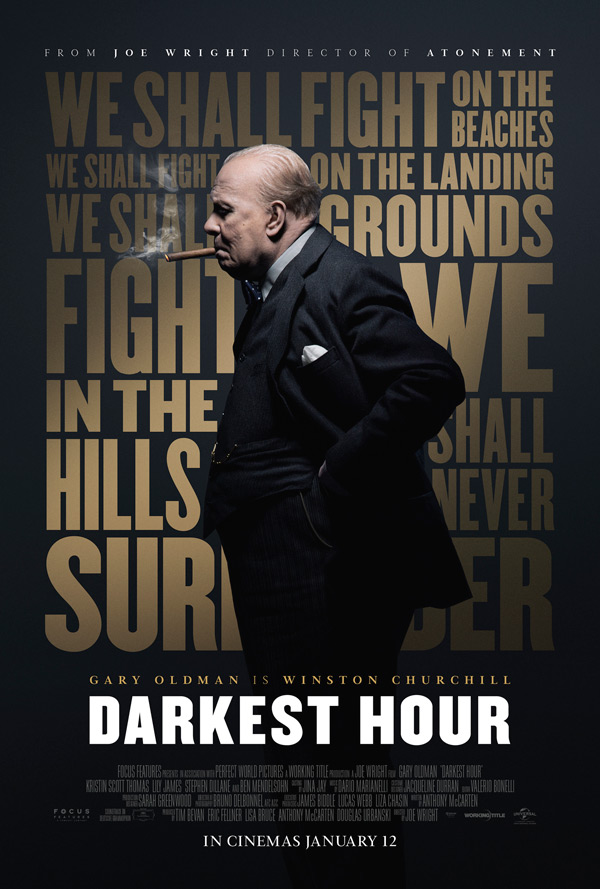
For me, Darkest Hour was an entertaining piece of political drama, more than an epic movie about WWII. As with many films recounting a true story, facts are often punctuated by fiction; the ‘amusing’ scene on the underground stands out, but is heart-warming in our current political climate. And that is surely where we are being encouraged to draw parallels?
The film avoids portraying the gravity of the situation on the ground, the threat to British civilization and its people, in favour of political debate on the options to deal with it. Perhaps the film would have been stronger were we to have ‘felt’ the weight on Churchill’s shoulders, not just been told about it? It also misses the opportunity to recount the King’s call for a Day of Prayer and Repentance throughout the British Empire during the height of the crisis. It is recorded that this led to some miraculous weather that grounded the German air force and enabled Britain to rescue its troops (ref: Dr Peter Hammond).
However, many are predicting an Oscar for Gary Oldman’s rousing and poignant portrayal of this great statesman – an honour he will surely receive. Alongside a strong, but mostly underutilised cast, he delivers patriotism, humour and pathos and, in his character, no shortage of what we would refer to today as ‘spin’ to achieve his objectives. It is a film well worth seeing and a great illustration of the importance of perseverance and standing up to and defeating evil.
Damaris Media have partnered up with SSAFA to produce a companion booklet for the Darkest Hour film, find out more about it here and download it for free!
Find out where the film is being shown near you at darkesthour.co.uk
I'm all right Jack
This year marks the 75th anniversary of the iconic ‘Desert Island Discs’ programme. Now a favourite on Radio 4, it was first broadcast on the BBC Forces Programme on the 29th January 1942. Each week a guest, called a ‘castaway’, is asked to choose eight musical recordings, a book and a luxury item that they would take if they were to be cast away on a desert island. At the end of the programme they choose the one piece they regard most highly.
In an age and culture where our lives can be so full of ‘stuff’ I’ve often pondered how liberating it might be to be a castaway; richness in simplicity, space to appreciate and value a few basic things, more time spent looking outwards and less time looking in. In addition to the ‘Complete Works of Shakespeare’ and the Bible, which castaways are given automatically, I’d probably opt for something like ‘The Hitch Hikers Guide to the Galaxy’ and a solar powered coffee machine, in the hope I found myself on an island rammed with coffee trees! My eight recordings would be tough, and maybe the subject of a future blog, for now I’m interested in charity; what we do with what we have.
In Luke’s gospel we have the story of Jesus’ encounter with a rich man. At the end of their conversation Jesus tells the man to sell everything he owns and give the money to the poor (18:18-30). Earlier we read about the man who builds bigger barns and hoards stuff in it for his future, only to lose his life the next day. (12:15-21).
What he did sounds familiar, I think immediately of my shed and my loft! This man didn’t choose to give his stuff to the poor or even sell it, instead he decided he simply needed more room, to keep more of his grain, for himself. All so that he didn’t have to worry about working in the future.
Let’s be honest, there is only so much ‘stuff’ we genuinely need and the only treasures we should really be storing up are those in heaven (Matthew 6:19-21). Nevertheless we hold onto things because we believe they give us security. We keep them because we may just need them one day. Lives full of ‘stuff’ leave little space for properly connecting with people and their needs; worse still, they become lives distracted from growing closer to God.
The idea of selling or giving away everything we own is quite scary. But it’s not, in the majority of cases, what I believe God calls us to do. Rather we are to be responsible for caring for the needs of our families and ourselves. What he does ask though is that we get rid of those things that have become more important than him (Exodus 20:3), that we turn our whole hearts and lives over to God. Our lives should be characterised by the sharing of our time, wisdom, money, and possessions with others.
With a fairly eclectic taste in music I’d be without some much loved recordings on my desert island, but the one I’d definitely take is “Echoes: The Best of Pink Floyd”. Track 10, “Money”, is about greed and hypocrisy – a guy hoarding all the money and possessions he can. The songwriter ends by reflecting on how we are often keen to see that these things are shared with people less fortunate than ourselves, as long as it’s not our ‘stash’. “Share it fairly, but don’t take a slice of my pie” the song says.
How about us?
Image Credit: Vitaly
Preparing for Battle
Before defeating the Philistines, King David inquired of the Lord, “Shall I go and attack the Philistines? Will you deliver them into my hands?” The Lord answered him, “Go, for I will surely deliver the Philistines into your hands.” After successfully defeating them at Baal Perazim, they came up again and spread out in the Valley of Rephaim. Once more David inquired of the Lord, and again the Lord gave him instruction for the battle. David did as the he’d been commanded, and the Philistines were defeated all the way from Gibeon to Gezer (2 Sam 5:19-25).
Not that long ago it would have been experts, experience or formal instruction we turned to when preparing for life’s challenges, I guess today it’s more likely to be the internet or social media.
It might be that we’re undertaking a new DIY task, getting ready for a significant sporting feat, helping children with their homework, or maybe just struggling with some new technology. The list could go on, as can the sources of advice. But as soldiers facing a battle, would we head for Google to prepare?
When I joined the RAF, in fact even when I’d left over 9 years later, the internet and social media weren’t options! Yet, I’m sure that even if they had been, we still would’ve been running around in full kit, carrying SLRs (rifles) and being bellowed at by an NCO as we undertook basic battle training. There is arguably no substitute for rolling up our sleeves and getting on with things! Which, by the way, is probably why most of us blokes never bother to read instructions!
So, if we acknowledge that tendency to ignore instruction and get stuck in when a task is unfamiliar, how much more likely are we to ignore it when we’ve faced a situation many times before?
Despite my maturity (in terms of days on the planet) it’s only in recent years that I’ve properly understood that every day we go into battle. Quite often it’s the same stuff, some days it will be new stuff, other times we won’t even recognise it as stuff that we need to deal with.
Jesus broke the power of sin by his death and resurrection. He disarmed and triumphed over the enemy Satan, yet there remains guerrilla warfare all around us. Warfare designed to damage, discredit, deceive, divide and discourage us. But in whatever way these battles confront us, we have the most comprehensive instruction manual ever written, the Bible.
As ‘soldiers’ for Jesus, we can ask some questions about our ‘battle readiness’:
- What sort of shape are we in physically, emotionally and most importantly spiritually? What’s our relationship like with God?
- Do we recognise that whilst there will be the familiar battles, the battlefield itself will change? We need to train and equip ourselves for every possible scenario. Gather as much information as possible about the ‘terrain’ (context), the people involved and the origins of these battles.
- Have we got all the kit we need and do we know how to use it?
- Are our combat skills up to scratch?
In his letter to the church in Ephesus, Paul talks about the ‘Whole armour of God’ (Eph. 6:10-18). We get this picture of a mighty General calling the troops to assemble in front of him, laying at their feet all the equipment they will need for the battle and instructing them to take it up immediately. The General of course is Jesus. As followers of Him we have a spiritual inheritance; we have forgiveness and peace and are encouraged to walk in His way, to stand firm, to hold on to what we possess. The battles will rage: the lies, the circumstances that convince us we’re not worthy, that we don’t have peace, that God doesn’t love us, or that we don’t need to forgive. Standing firm means claiming the ground, holding on to it, conceding nothing back so that we are remain in a constant state of readiness.
Maybe it’s a bust up with a mate, an occasion when money is tight, or when someone close becomes seriously ill. Perhaps it’s following a period of prayer about something significant and circumstances turn out completely opposite to what we’d prayed for. Each of us will experience things that threaten the territory we possess, each of us will risk compromising who we are in Christ by the ways we think, talk and act.
In that story from 2 Samuel, David fought his battles the way God instructed him:
- He asked if he should fight.
- He carefully followed what God told him to do, and
- He gave God the glory
As we prepare for battle, let’s be praying for that trust and obedience that David demonstrated. Let’s be standing shoulder-to-shoulder, clothed in the whole armour, and always ready. Secure in the knowledge that God is with us and because, as a mate reminded me just the other day, for every battle fought will come blessings.
Image Credit: Christian Allard
Putting God First
There’s a book on the shelf in our daughter’s bedroom that has been a favourite of all four children. Not Now, Bernard, by David McKee, tells the story of parents too preoccupied to notice a monster has eaten their child.
Like Bernard’s parents, there are so many things that compete for our attention: work, families, hobbies, the list goes on. Unquestionably we have a real challenge preventing them from becoming more important or more of a priority than our relationship with God.
Jesus said, “Worship the Lord your God, and serve him only” (Matt. 4:10) It’s true we don’t set out with the intention of ‘worshipping’ these other things, but they can easily control our thoughts and energies. Allowing God to hold the central place in our lives keeps these things from turning into gods.
But in a world that encourages ‘self’ how do we live a life with God at the centre? The world tells us men to be someone, to achieve, to live the good life. However, the life of a Christian is characterised by selfless service to God, flowing from a love for Him and our neighbour. Any success, influence or talents we are blessed with is set aside for building the Kingdom (Matt. 25:14-30).
Perhaps foremost is the discipline of daily prayer and time reading our Bibles. By spending time in God’s Word we’re able to draw on wisdom, encouragement, comfort and inspiration for every conceivable situation we could face. Making God our first port of call enables us to face all things in His strength.
But putting Him first is also revealed in how we answer some simple questions:
Is God first in our relationships?
Can our love for God sustain a difficult relationship, with a partner, child or sibling? Can we still extend unconditional love to that person at work or across the street who we really don’t like? “We know that we have passed from death to life, because we love our brothers. Anyone who does not love remains in death” (1 John 3:14).
Is we are in work is God first in the workplace?
No matter where our workplace is: home, office, factory, building site, behind the wheel, we serve God, who expects our work to reveal integrity and true diligence. “Whatever you do, work at it with all your heart, as working for the Lord, not for men” (Col. 3:23).
Is God first in our church life?
Each of us has been blessed with unique gifts. By humbly serving in our church we’re building up the Kingdom of God. “Now you are the body of Christ, and each one of you is a part of it” (1 Cor. 12:27).
Is God first in the giving of our time and money?
Do we have a generous spirit? Inviting God’s sovereignty over our finances and time brings fullness and contentment. Jesus says, “But seek first his kingdom and his righteousness, and all these things will be given to you as well” (Matt. 6:33).
Is God first in our leisure?
Hobbies and interests help us to unwind from the routine of life; to relax, to let off steam, to be entertained, and that’s great, we just need to be wise with our choices, ensuring we’re not preoccupied in the pursuit of the next buzz, the next rush. “Be very careful, then, how you live—not as unwise but as wise, making the most of every opportunity, because the days are evil” (Eph. 5:15-16).
Ultimately it’s not a case of ‘God first then focus on the rest of our lives’. But rather that God is in everything and in every way a part of our daily living. Its being intentional about making God’s agenda our agenda, God’s will our will, caring about what God cares about; because we live every day with an awareness of the presence and power of Him. “‘For in him we live and move and have our being” (Acts 17:28). God is worthy of our attention in everything we do, in everything we say, and in everything we think.
Think about how our time reflects our relationship with God. Are we too busy for God? What needs to change in our lives to devote ourselves more fully to Him? How can we better lead our families? How can we better set an example and be a witness to our colleagues? Is God, like Bernard, vying for our attention, warning us of a monster? Are we too preoccupied to take notice?
Image Credit: Bhavyesh Acharya
What was that all about?
This year marks the 30th anniversary of the ending of the longest war in history. The 335 Year War (as it is now known) was a conflict between the Netherlands and the tiny Isles of Scilly off the south west coast of Cornwall. It all kicked off way back in 1651, during the second English Civil War, but throughout this long period there were no casualties, no battles, not even a single shot fired. Probably because, for the vast majority of that time, neither side was even aware that they were at war! It’s a fascinating story, which I’d recommend looking up.
Reading it myself got me thinking about how, in our lives, we can be involved in lengthy periods of conflict, yet often with little recollection of the original ‘disagreement’. What was it all about, how did it start and why has it lasted for so long? Maybe it’s a friend that we don’t talk to anymore; a neighbour we avoid; or someone in the family we simply can’t be in the same room as.
On a well known counselling organisation’s website, advice concerning the resolution of conflict seems to fall under three less than encouraging headings:
1. Resolve it
2. Let it go
3. Minimise contact or cut off completely
Thankfully the Bible has plenty of good advice on the subject. God tells us that His ways are not our ways (Isaiah 55:8); His ways are much higher than our ways, and invariably run counter to our ways. So if we’re serious about achieving peace in our relationships, we need to respond to conflict God’s way.
In the majority of cases, drawn out periods of conflict come from a dislike (often a deep dislike) of another. However difficult the dislike is to solve, we should be demonstrating the unconditional love of Christ to the person or people we’re in conflict with (Luke 6:27). If we say we love God that includes loving all those created in His image (1 John 4:20-21). No matter what the disagreement we should never stop praying for those we’ve fallen out with. We should be quick to listen, slow to speak and slow to become angry (James 1:19). We should take a step back from the hostilities and consider whether we share common goals that are bigger than our differences, appealing to those common interests as we seek a resolution. Of course we also should forgive as the Father forgives us (Coll 3:13). When we recall God’s infinite love and forgiveness we are much more able to love and forgive others.
With the signing of a peace treaty by the Netherlands ambassador, Mr. Rein Huydecoper, on 17th April 1986, I’m relieved that we no longer have to choose between Royalist or Parliamentarian armies when visiting the south west! But what about those long unresolved conflicts in our lives today? We’re unlikely to get 335 years to settle our differences, but if we prayerfully commit today to healing those old wounds, God can do truly amazing things through us.
