Author Archives: Jonathan Sherwin
Is Britain A Religious Country?

Where were you when you first experienced elation? I have vague, early-childhood memories of blissful birthdays with cakes shaped as Subbuteo pitches and parties at water parks. In my teenage years I hit new heights kayaking down French alpine rivers, dodging rocks and trees, mostly the right way up, to be rewarded with pure adulation coursing through my veins at the finish.
Of course, in sports, there was the 2003 Rugby World Cup final, that 5-1 against Germany, the Miracle at Medinah, Super Saturday, and last year when Tuilagi opened up the All Blacks’ back line like a bayonet through a pack of ravioli.
When I recall these memories I find my mind has assiduously mapped out the little details surrounding the events. It was as if I was a little bit more conscious, a little bit more alert. I felt more alive; and it felt good.
It’s little wander that we spend good money and much time pursuing things in life that leave us feeling good. It is, after all, nice to feel good. Great experiences, like a concert or climbing a mountain or a fantastic holiday, cause us to seek for further great experiences.
When we come back from our travels the first question often is, “Where next?” The pursuit of pleasure leads us to open up our wallets and map out our time with war-room-like efficiency.
Now currently, we are told that around 12% of people in Britain attend some kind of church once a month. On that basis, one could conclude that our country isn’t particularly religious, yet our behaviours I think tell another story.
Consider the humble football fan. He supports the team his father did, and lives locally enough to make it to most of the home games. He has a season ticket, and a draw in his bedroom with team shirts of years gone by. After the game he comes home and turns on the TV to watch the highlights and catch up on the rest of the league.
Through the ups and downs and the comings and going of new managers, he sticks by his team. Visiting regularly, checking the website, inviting his friends, and spending his cash. What about that is not religious?
And to an extent I’m with him. Saturday evening, when the world is a little quieter, I quite like a bit of Match of the Day. I like the routine, the familiarity, the ‘quick fix’ of action, and of course, catching the goals. And apparently I’m not the only one with around seven million viewers tuning in over the weekend.
Having now been going for 50 years, it really has become an institution. In the recent ‘Match of the Day at 50’ program, Thierry Henry when asked about his thoughts on the show replied, “It’s like going to church, you know, it’s a religious thing. It’s part of the culture in England.” I think he’s spot on.
And in this statement I think lies the fact that Britain is indeed a religious nation. It is a religious nation because it is a nation of worshippers. No, it might not be the Christian God or another religion that the majority of the people turn to for comfort and hope, but it will be something.
In our lives we have these sunshine-through-the-clouds moments, mini-revelations or periods of elation perhaps. We stare at them, think on them, analyse and run after them because we are looking to orientate our lives in a certain direction.
We worship. The choice we have then is what or who do we worship? What or who is truly worthy to be worshiped? Many of us are content to fix our eyes on the moment, the experience, the snippet of ecstasy and miss the author of all these things, God.
The next time you hit a high, enjoy it. Enjoy it and be thankful, and then, perhaps the next day when you wake up, why not begin to investigate why you are grateful and to whom you ought to offer your thanks?
Jesus: The Evidence
“it seemed good to me also, having followed all things closely for some time past, to write an orderly account for you, most excellent Theophilus, that you may have certainty concerning the things you have been taught.” (Luke 1:3,4, ESV)
Luke, when composing his gospel – his account through eye-witness testimony of the life of Jesus Christ – prefaces his book with his reason for writing it. Luke is providing an “orderly account” for a chap named Theophilus, that based on the facts, Theophilus might know for sure what has happened with this man named Jesus Christ, and that there is evidence to the stories that he is hearing.
Christian belief has always rested on the evidence for the life of Jesus Christ. Faith isn’t hoping that the nice things we hear could be true, but an assurance that they are true because God really entered space-time as Jesus. Faith in Christ is supplied through hearing about what actually happened and what it means for us now.
Derek’s Journey
Derek was an agnostic who began to look seriously at faith later in life after some conversations with a friend who was a Christian. Having been brought up in the UK, it wasn’t as if Christianity was totally alien to Derek, but he hadn’t taken it seriously until this point. As Derek writes,
In my late 30’s I thought it would be worthwhile revisiting some of the questions I’d left unresolved in my teens. My thoughts were that as there are plenty of capable and intelligent people who profess to have some form of belief in God (eg. Scientists like Albert Einstein and Stephen Hawking. Politicians like Nelson Mandela. Military men like Sir Richard Dannatt and Norman Schwartzkopf etc). In a survey published in “Nature” in 1997, four out of 10 scientists said they believed in God.
Well, Derek’s friend sent some books over, outlining the evidence for the person of Jesus Christ. This was completely new to Derek.
I was amazed by what I found. I was amazed by my own ignorance of the evidence I found. How could I be living in a country where Christianity is the dominant religion and not be aware of this stuff?
Starting from these books Derek was on a journey of building his faith upon the evidence of the person of Jesus Christ. He was so impressed by this, that he then decided to collate all the different sources and create a booklet and website: Jesus: The Evidence to share with others.
Download your free copy of Jesus: The Evidence, where Derek looks at:
- The Sources of Evidence
- Who Was Jesus?
- Resurrection: The Evidence
Would You Benefit from Jesus: The Evidence?
Derek presents the course at locations all over Scotland. If you’re interested in hearing more, take a look at the presentation schedule for the rest of the year.
Perhaps you think that your church would benefit from this talk too. Why not host your own Jesus: The Evidence presentation? Contact Derek for more on this.
Out With The Old, In With The New?
New is cool. At least, this is what the advertisers would have us believe. If you don’t have the latest thing then you’re not ‘with the times’, or so the implied message behind the images selling us the thing tells us. And do you know what? So often the advertisers are right. My current phone is a better version of my old phone. It has a longer battery life and a crisper display. The old phone wasn’t bad, per se, but this phone is clearly an improvement upon the old one. In a few months I’m sure I will be told about the latest development and how it’s faster or bigger or slimmer etc. and how much I need it. The march of technological progress soldiers on.
This progress requires change. The change ought to be an improvement on the old, but at the very least it needs to be different from the old. It needs to be distinct. If what is new isn’t different then it becomes hard to sell. If Volkswagen were to believe that their Golf has finally ‘arrived’, that it couldn’t possibly be any better, that it should look and perform this way forever, it would in a few years time look dated and most likely be out-performed by its rivals.
In a world obsessed with things and the production and selling of them, an environment of constant change must be manufactured to keep the supply chains rolling.
Now, change is good, but only whenever it actually is good. I like that my latest car is more reliable than the car it replaced and that the fuel economy is better. I like my new running shoes because they fit well and make running almost a joy again. All change that is good is only good if it is in fact an improvement upon what it is replacing.
But from a marketing perspective change doesn’t need to be good. It only needs to exist. If we can be told that we need something new, simply because it is new, then we can be persuaded to buy it independent of an analysis of what it actually is and whether it really is any good. And when we make a purchase, the company selling to us makes a profit, and can continue to employ marketing experts to go on convincing people of needs that they have, and therefore sell more of their products.
What is sold to us today is most definitely a way of life, being offered through the product being advertised. Adverts don’t just sell to us on the merits of the product, they seek to convince us that we will be better people because we have and use these products. In this world we live in we are told that change is good and life is better when we are playing with the latest thing.
In the current climate, it has therefore become all too easy to assume that things that are old are of lesser value than things that are new. Your first TV will most likely not be as good as your current TV. But so too have changed what you used to think about, say, politics, or your goals in life, or where your ultimate holiday should be. Those old ideas have been replaced by newer, improved, and updated versions. The naivety of our youth is superseded by the wisdom gained throughout life.
Except that not all things that are new are good, are they? Ancient Roman buildings in England have outlived modern buildings, hundreds and hundreds of years younger. I’m sure that in the 1970s, a period I blissfully have no memories of, the taste of the day in interior design was a real high point! Those greens, harvest golds, and burnt oranges etc.. Linoleum: what a wonderful and practical solution for the floor of a kitchen. Fashions come and fashions go, but the reasons for them doing so may seldom be practical or thought through.
So too the ideas, philosophies, and religions of our culture, they ebb and flow. They may be in fashion one moment, and out the next. But we would be foolish to dismiss the great ideas of our past, of our heritage, simply because we prefer the new.
The great author C. S. Lewis was brought to task by his friend Owen Barfield when, as a younger man, he dismissed Barfield’s viewpoint simply because it was old. Lewis came to realise that he was engaging in “chronological snobbery” and that the truthfulness of an idea has little to do with its age”. When contemplating an old fashion or idea Lewis wrote that,
“You must find why it went out of date. Was it ever refuted (and if so by whom, where, and how conclusively) or did it merely die away as fashions do? If the latter, this tells us nothing about its truth or falsehood.”
Perhaps in our nation today faith in the Christian God, although once popular, is now no longer fashionable. We would do well to heed Lewis’ advice and not dismiss it because of its age or association with previous generations. It must be investigated and examined on its own merits. We can either choose to inform ourselves through careful enquiry, or float along upon the tide of culture, receiving our viewpoints and tastes from the budgets of big companies and the ideas in vogue from mainstream outlets.
This next time you’re at your Dad’s house, look at his photos – the ones in the older albums. Do you see how silly those trousers look? But be warned, the next laugh you’ll hear will be in 30 years when the future generation simply cannot fathom what we were thinking when we donned skinny jeans.
What seems right in our day will seem old in the future. Change cannot alone be the measurement for truth. We might cringe when we look back on our old fashion choices, but how much more will it hurt when we realise we dismissed God only because he was ‘so last century’.
The Bible – Part IV

“The West became a humane civilization because it was founded on the precepts of a teacher who insisted that man was valuable.” – Vishal Mangalwadi
It is without question that Christianity has changed the face of the world, and it has done so on the back of the Bible. This ancient book carefully composed, transmitted, and passed accurately through generations has instigated positive political, social, religious, and economic reform.
Catch Up
For example, In 17th Century Scotland, Samuel Rutherford – a preacher – read his Bible and saw that all men are created equal under God. Rulers weren’t meant to lord it over their subjects. Reasoning from Scripture, Rutherford argued that Kings are not above the law, but that they are held to a higher law. At first rejected in Great Britain (Oxford University burned the book), it influenced the founding governmental systems of the United States of America, and eventually led to political reform limiting a monarch’s power here too.
Schools and Universities have been established by people reading their Bibles. Hospitals and healthcare programs have been created also. The Salvation Army tackles poverty. William Wilberforce, reading his Bible, campaigned to end the Slave Trade, and while he was at it set up the Royal Society for the Prevention of Cruelty to Animals (RSPCA).
So how is it that the Bible, a mere book, can cause so much change? It is because, in short, the Bible gets the answers to the basic and grandest questions of life right. It’s not that men read a parable or a Psalm and have a creative idea in the shower that sets their whole life on a path to reform (although that may happen), but that when we read the Bible as a whole, as a complete book, we see it speak accurately to three key areas of life: our value, our condition, and our hope.
Our True Value
Firstly, the Bible tells us that human beings are valuable. Being made in “the image of God” (Genesis 1:26,27) endows human beings with dignity, worth, and value. No other part of Creation is made in God’s image. All of Creation is made “good” but humans are set apart, marked as special.
This goes a long way to a firm ethical foundation for the treatment of humans. Why is it wrong to enslave other people? Because all human beings are equally valuable. Why should we not murder? Because all human beings are equally valuable.
In the New Testament the true value of humans is marked by the extraordinary sacrificed of Jesus Christ. God’s own son, come to die to save us. The philosopher Alvin Plantinga calls this the “greatest good” – the best thing we can think of our imagine – and it happened for us.
Two Excesses
Humans are prone to two excesses when we remove the Bible as the yardstick for our worth. Firstly, we can think too little of ourselves. One could reduce humans to be of equal value to animals, or other living things like trees. After all, if all we are is simply another type of animal – albeit more highly evolved – then let’s treat each other like animals. Perverse sexual ethics, ethnic cleansing, and slavery all become hard to argue against when we take this position. If we aren’t any more special than any other random collection of atoms, then why should we treat each other as special?
Equally, we can also think too much of ourselves. If there is no God, perhaps we are God! We might think that we are the very best, and we can do what we want. We could argue that we can dominate nature because we are God. When our value is too high we make all other things serve us. Why bother, for example, about taking care of the environment when it is there only for us to use as we like?
The Bible values humans correctly, neither too high nor too low. On this base we have built civilisations that protect and defend human rights, and argue against excesses committed both against and by us.
Our True Condition
The second question that the Bible accurately answers is the question of the condition of humans presently. That is, what state do we find ourselves in today?
The Bible tells us that humans are both fallen and finite. These are worth looking at, so let’s unpack these two attributes.
When talking of our fallen nature, the Bible says that the condition of man is marred by sin. We were created as “very good” but when sin entered the world, our condition deteriorated. We were created as good, and for good things, but now we operate in an affected state. This means that our intentions are not perfect. Our actions don’t always hit the mark. We are capable of great good, but equally we are capable of great harm.
Because we know this, we can create systems to help limit the damage done by our bad choices, and promote those things that are good. We can limit our governments from making harmful decisions, whilst investing in them the power for positive change.
Coupled with this, the Bible tells us that we are finite. We are created with a beginning, and with limits. Only God is infinite. We have not always existed. This properly articulates our limitations, that is, we have this one life. The life we’re living now is the one that we have been giving. The years we live on this earth on these bodies are the only years we have. We have existed before and we will be reincarnated in the future.
What happens in this lifetime is therefore of great importance. This is our life, now.
Two Excesses
Again, without the Bible humans can go one of two ways when attempting to answer this question for ourselves.
Firstly, we can say that there’s nothing wrong with us. We aren’t in any way broken. Perhaps we’re on an evolutionary scale, getting better and better, but we’re not inherently restricted. If only we were to “free our mind” or “realise our potential” we can alleviate the suffering of ourselves of and of others. If we try really hard, we can create perfection because at our core we are perfect.
Communism is an idea that wants perfection. It desires harmony. It longs for unity. But without correctly diagnosing the condition of humans that we face, it fails to understand that left alone, we can’t arrive at perfection, because we don’t have the capacity for perfection within us. All of the education, all of the money, all the goodwill and charity in the world will not solve our problems, because our problem is much deeper. Our problem of sin hampers all of our efforts.
On the opposite side, we can observe all of the problems and conclude that we are totally broken and beyond help. Life quickly becomes meaningless when viewed this way. Pessimism leads to despair. “Why bother?” is the operating slogan. We have all these problems and nothing to fix them with.
When the Bible describes our fallen states, it doesn’t say that we lost all of ability for good. Although the Bible says that we aren’t and can’t be good enough to fix our problem, it doesn’t say that we can’t use our minds, our finances, our time to help others, to cause there to be more good in this world.
By correctly labelling us as both “good” and “broken” the Bible shows us our limits, and points to the need of outside help. We’re not too optimistic about our condition, but neither are we too pessimistic.
Our True Hope
After answering the questions of our value and our condition, we need to ask, “Where is our hope?” What are placing our trust in?
When the Bible tells us that are both valuable and broken, it doesn’t leave us to wallow in the theatre of “what could have been” dreams. We aren’t resigned to pondering “If only …” thoughts.
“For God so loved the world, that he gave his only Son, that whoever believes in him should not perish but have eternal life.” (John 3:16, ESV)
Through the death and resurrection of Jesus Christ, God come as a man, we are given a true and dependable hope. We will be restored to completeness again, our sin-condition will be removed once and for all. This isn’t something that we achieve for ourselves, but something that God does for us. We can’t earn it; God freely gives it.
We have reason to live, a reason to strive for great change and resist evil, and we have assurance of this too.
Man with God can do great things. Man with God can face the problems, the terrors, the horrible things that blight our world, and say that they won’t always be this way. We can wake up, and with God’s help make a change this very day. A true change that leave its mark for all eternity.
Because history is going somewhere our efforts have lasting value. Because we know who is leading us to salvation, we have true confidence.
Two Excesses
Without God involved in the picture humans have to place their hope in either something else, or nothing at all.
If we decide to say there is no ultimate hope, no chance of redemption or salvation, then all of our efforts operate under the banner of “It’s all for nothing”. We can ignore our conclusion and try to eat and be merry, for tomorrow we shall surely die. Or we can stare this harsh conclusion square on and live congruently with our conclusions. “What really is the point of anything, then?” we muse. Such painful answers lead to despair and misery, and sometimes insanity.
The other angle humans explore is that of placing our hope in something else. This could be ourselves and our good deeds, or our children, our countries etc. Anything good can become God in this case, our ultimate hope and answer for meaning.
These other areas may hold up for a while, but under the enormous pressure of ultimate hope every good thing collapses. Our marriages, our careers, our hobbies – they were never strong enough to save us. We might invest large chunks of our lives in the belief that if we apply ourselves diligently to these or other areas they will deliver. On the day that they let us down, devastation can reign. Stockbrokers who lose it all in a crash can contemplate taking their own lives. Children who disappoint can overwhelm their parents with a wave of grief that they don’t recover from.
A good thing can become a terrible curse when we expect it to deliver us to the promised land. Instead of enjoying it for its goodness, we promote it to Saviour and when it fails us we can simply fall apart. Our hope evaporates and sucks our security with it.
The Bible has a term for the misapplication of hope to finite things: idolatry. We make idols out of other things and, in a way, through our time, money, energy worship them. When the Bible forbids worshipping idols it’s not the laws of a tyrannical, needy despot who cannot stomach the loss of attention, but the best guidance from a loving Father who knows exactly what we need and tells us exactly where we can find it.
By answering these questions correctly the Bible properly describes reality to us. We can see ourselves as God sees us, as we really are.
This self-knowledge is vital for when we answer the basic questions incorrectly we can not live the best way, and our efforts will fail. Our views of the world and of each other are deficient until we see God and in his reflection see ourselves.
The Bible has changed the world because humans have read it, discovered how truly valuable they are, learnt of their broken condition, and delighted themselves in the assurance of the great promise of Jesus Christ of ultimate salvation and redemption.
The truth is discoverable, it is knowable, and it is available in a bookshop, a library, or a bed-side cabinet near you.
The Bible – Part III

The Bible is an extraordinary book. As well as being the most-read, and the best-selling book in the English language – and in nearly every English-speaking hotel bedside table – it stands up exceptionally well to various tests put before it. In part 2 of this series we took a look at the evidence for the reliability of the transmission of the original texts. That test shows that we can be pretty sure that what we read in our Bibles today is what was originally composed by the authors of the texts.
Catch Up — Part 1: Bible Facts — Part 2: The Bibliographic Test
In this article we’re going to pay closer attention to what is actually in these biblical writings, and to the style in which they were written. To affirm the question of the history of the transmission of the Bible is crucial if we are to trust the documents in front of us, however it is quite another thing to trust that the authors were writing a) accurately and b) truthfully.
We might today be confident that we know what was written, but can we have any confidence that was written is a faithful and true account? To answer this, let’s ask some questions of the text, questions – as with the Bibliographic Test – than can be asked of any work in history.
And let us here for the sake of brevity focus on the gospels, the testimonies to the life, death, and resurrection of Jesus Christ. After all – if we get Jesus wrong then Christianity falls apart completely. So, here are three questions we can pose when internally examining the New Testament.
1. Were the authors of the New Testament gospels trying to write history?
Christians would claim that the gospels of Jesus Christ – Matthew, Mark, Luke, and John – are historic, in that they record faithfully the life and ministry of Jesus Christ. But how do we know that the authors were aiming to write historical accounts? Perhaps they were writing stories, allegories, or myths. Not that they were fabricating truth, but that they never intended their writings to be read as history, but merely as story.
Yet when we look at the gospels we immediately see the authors writing in a biographical fashion. That is, the style in which they write is in line with the normal historical writing conventions of their day. The gospels read as other historical accounts from the time do.
David Aune, a professor from Notre Dame University, remarks:
[Ancient biography] was firmly rooted in historical fact rather than literary fiction. Thus while the Evangelists clearly had an important theological agenda, the very fact that they chose to adapt Greco-Roman biographical conventions to tell the story of Jesus indicated that they were centrally concerned to communicate what they really thought happened.
What do we man by these biographical conventions? Well, for a start, the authors go to the trouble of naming people, places, distances between places, and regional variables on all manner of things like the botany in the area. This was not the style for fictional writers of the time. Fiction didn’t care about facts, places etc. – it wasn’t written to convince you of an alternate but plausible reality.
When I was a teenager I started reading Tom Clancy novels. Having a submariner for a father, I started with The Hunt for Red October and moved through the Jack Ryan series from there. These books captured me. The political intrigue and preludes to war were thrilling, but it was the battle scenes that grabbed me. There would be hundreds of pages dedicated to the battles. Detail after detail of the planes, the ships, and the people, drew me in. The blow-by-blow realism of the text brought me into Clancy’s created world. It made it real to me. Clancy was creating a universe parallel to our own and sucked his readers into it. We knew it was fiction but we loved it because we believed that it could be real.
But this form of writing is relatively new. For most of history, fiction didn’t come to us this way.
C. S. Lewis – whose day job was teaching Mediaeval and Renaissance Literature –knew a thing or two about fictional writing and said this on the matter:
I have been reading poems, romances, vision literature, legends and myths all my life. I know what they are like. I know none of them are like this. Of this [gospel] text there are only two possible views. Either this is reportage…or else, some unknown [ancient] writer…without known predecessors or successors, suddenly anticipated the whole technique of modern novelistic, realistic narrative.
“Realistic narrative” was not the order of the day. So, upon inspection, the style of the New Testament gospel authors is that of Greco-Roman biography. Matthew, Mark, Luke, and John were writing in such a way that has all the hallmarks of appearing to be history.
So the gospel authors weren’t trying to write a nice, but made up, story. They were writing history. But, were they telling the truth, and were the eyewitness sources that make up the four gospels accurate? Let’s take a look.
2. Can We Trust The Eyewitness Accounts?
Luke starts his gospel in this way:
Many have undertaken to draw up an account of the things that have been fulfilled among us, just as they were handed down to us by those who from the first were eyewitnesses and servants of the word. With this in mind, since I myself have carefully investigated everything from the beginning, I too decided to write an orderly account for you, most excellent Theophilus, so that you may know the certainty of the things you have been taught.
Luke by his own words demonstrates his intent to provide an eyewitness account of the life of Jesus. In this way Luke is following the traditions of the day in which it was assumed that a historian should be writing history when the eyewitnesses to that event were still alive in order that their testimony may be examined.
Polybius, the Second Century BC Greek historian said that the role of the historian was, “to believe those worthy of belief and to be a good critic of the reports that reach him.”
History was written at the same time that the events of note were under investigation, rather than years later. Eyewitness testimony was the backbone of the historical report. So in order to ascertain the veracity of the historical events we need to question the reliability of the eyewitness accounts.
It is worth noting here that we don’t think that any of the four gospels were written inside the locations which they reference. We think Matthew was written in Syria, Mark in Egypt, Luke in Rome or Antioch, and John in Ephesus. Things got pretty hot in and around Jerusalem after the crucifixion of Jesus, and many Christians left.
Yet this fact, rather than undermining the authority of the accounts, serves to reinforce them. For example, Mark, writing in Egypt, was writing about people and places in and around Jerusalem. Of particular note are the names of people Mark mentions. There was a Jewish community in Egypt, where scholars believe Mark wrote his gospel, and one line of reasoning suggests that if Mark were simply making up the history he would borrow the names and practices of the Jewish community where he was and transplant them into his story.
Except that we know that the two cultures had differences. First Century Egypt and Palestine had a common history, but in much the same way that the United States and England have a common language and a common history, yet the culture of the two nations have their own particular nuances. The top-ten baby list from the US does not read the same as the top-ten baby list from the UK. In Richard Bauckman’s book Jesus and the Eyewitnesses one particular piece of research looks at the common names in Egyptian Jewish culture and Palestine Jewish culture. Mark’s gospel both mirrors the frequency and popularity of the Jewish names that are found in Palestine, not Egypt. This information was acquired after extensive, yet modern research, and there is no way that Mark would have known this when writing in Egypt nearly 2000 years ago.
Furthermore, place names and distances between places are accurate. And when, for example Luke talks of Sycamore trees in Jericho, well, yes – Sycamore trees do grow in Jericho! But they didn’t grow everywhere; only someone who went to Jericho would know this fact.
In the film Ronin there’s a scene in which Sam (Robert DeNiro), playing an undercover CIA agent (undercover) confronts Spence (Sean Bean), who is claiming to have been in the SAS. DeNiro sniffs out Bean’s lie – he wasn’t ever special forces – and catches him out with details that only he would know if he had been to Hereford, and trained with the SAS.
The accuracy of the details of the eyewitness accounts authenticates the gospel documents and reveals them to be truthful. In short, we can rely upon them to tell us what really happened. Far from shying away from details that could sink the testimony, the authors were impressed to include those very details to prove their accounts. The evidence does not falsify the history, but strengthens and support the writer’s claims.
3. What Was In It For The Authors?
Finally, it’s worth taking a moment to examine at the authors’ motives. It is a common objection that, well, of course the New Testament writers wrote what they wrote. They were looking for ways to propagate their agenda, to tell their story, to spread their ideas.
Much of the sting of this accusation has been handled by the last two questions that we have levelled at the texts. But let us now look directly at this issue.
What did these authors stand to gain? Fame? Money? Influence? These and other lures have motivated countless men and spawned more than a few false religions. So why not Christianity too?
I think we can get to the heart of this but balancing what the authors and early teachers of Christianity could have gained with what they stood to lose, that is, their lives.
Of the twelve disciples that Jesus had, ten were executed. Simon (Peter), Andrew, James son of Zebedee, Thomas Didymus, Bartholomew, Philip, Matthew, James son of Alphaes, Jude, and Simon the Zealot were all executed for their faith. John, the brother of James, died of old age and Judas hanged himself.
The early Christians were labelled as atheists by the Romans and Heretics by the Jews. In their world safety simply evaporated. The testimony of the early Christians could be their death sentence. When faced with death, a man has nowhere to hide and his beliefs are purified by the glare of his imminent destruction. As Blaise Pascal put it,
“I believe those witnesses that get their throats cut.”
What Does the Rest of History Have to Say?
We’ve looked elsewhere at the evidence for Christ outside of the Bible. We’ve seen how Roman, Jewish, and later-Christian history corroborates the Biblical accounts.
Furthermore, Archaeology has been increasingly helpful in backing up Scriptural facts, as Nelson Glueck points out:
“It may be stated categorically that no archaeological discovery has ever controverted a Biblical reference. Scores of archaeological findings have been made which confirm in clear outline or exact detail historical statements in the Bible. And, by the same token, proper evaluation of Biblical descriptions has often led to amazing discoveries.”
Quite simply, the Bible has stood up to scrutiny within and without. It has answered questions of transmission, questions of accuracy and style, and questions of correspondence to external sources.
So there you have it, the Bible – quite a book. And if we take all that we have covered so far, it presents a challenge to every reader. If you’ve never read the Bible, or if you’ve read it only lightly assuming it to be ancient fiction, in light of these facts, try reading it again. Read the message it is proclaiming and ask yourself what your answers to the challenges it poses to you are: namely, who do you think you are, and who you do think Jesus Christ is?
The Bible – Part II

Have you heard something like this following objection to the reliability of the Bible?
“Well, how do we know that what we have in our hands today is what was written by the authors? How do we know that the text hasn’t been modified to suit the political, theological, and personal aspirations of countless numbers of people throughout the ages?”
In this, the second article of the series, we are examining the history of the transmission of the texts, through the use of the Bibliographical Test.
(Missed part one? Catch up now.)
The Bibliographical Test
When dealing with any book of antiquity, including the Bible, we can subject the texts to scrutiny to examine where and when they came from and how they got into our hands today.
One big question that we would want to know would be, ‘Is the copy of the text that I have now reliable?’ That is, have the words been changed since they were first written down? If the answer is, ‘yes’ – there have been substantial revisions of the text – then we lose credibility of the historical testimony that the Bible offers. We then move from the realm of the Bible being reliable as ‘evidence’ to simply some ‘nice ideas’.
But if the copies that we have today are shown to be accurate to their original manuscripts, then we can say that we have a true representation of what the authors wrote. Of course, you may well say at this point, ‘Well how do we know the authors were telling the truth?’ And that’s a great question. This specific test doesn’t deal with this question, but other tests that we will be looking in Part III do. But first things first, is what we have now what was written then?
To begin with it’s worth comparing the Bible to other famous literary works of history and see how many manuscripts, or copies of the original works, we have.
At this point it’s important to note that we don’t have any of the original autographs. That is, we don’t have, for example, the actual letter St Paul wrote to the Roman church. For that matter, we don’t have any of the originals of the other works we’re mentioning here.
Plato, Caesar, Sophocles, and Homer all wrote various pieces of literature in a similar time-period so let’s look at those.
The Number of Manuscripts
Firstly, let’s establish how many manuscripts we have from history.
- Plato’s Tetralogies: 210 manuscripts
- Julius Caesar’s Gallic Wars: 251 manuscripts
- Sophocles’ Plays: 49 manuscripts
- Homer’s Iliad: 1,757 manuscripts
- The New Testament: 24,633 manuscripts
The vast number of manuscripts of the New Testament is both startling and illuminating. It:
- Shows us how much attention it received by others, and
- Gives us a greater spread of evidence when ascertaining how much change has occurred between the manuscripts.
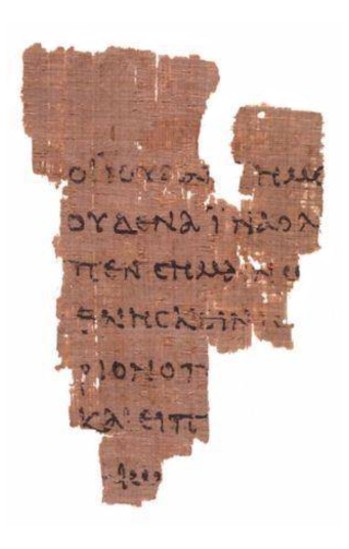
The John Rylands ‘P52’ manuscript (now in the John Rylands Library, Manchester). Discovered in 1920 it shows a portion of John’s Gospel (Chpt. 18 vv. 31-33).
Additionally it is also worth noting that outside of the manuscripts, we have over 36,000 quotes from the New Testament, from the early church fathers, such as Justin Martyr and Origen. Taking just these quotes, we are able to reconstruct the New Testament to within 11 verses of the complete text. We’ll look some more at external sources later in the series.
Taking the 24,633 Greek manuscripts and comparing them one to another over the whole of the New Testament, about 20,000 lines of writing, it has been established that we can observe a 99.6% correlation. What does this show? This is profoundly remarkable as it demonstrates that the copies we have are very, very similar. If there had been many changes, then when the copies were compared there would be significant differences. These just don’t exist in the historical record.
The conclusion we can very reasonable draw is that this evidence shows that the Biblical manuscripts have not been altered since the earliest manuscript that we have. The next point of investigation focuses on how big the gap is between the original work and the first manuscript that we have found.
Time Gap
In comparing the gap between the first manuscript and the date of the original composition of the text, we’ll include some of those other works from history.
- Sophocles lived between 496 and 406 BC. The earliest manuscript we have is from the 3rd Century BC (100-200 years later).
- Plato lived from 427 – 347 BC. The earliest manuscript we have is from 895 AD (1300 years later).
- Scholars date The Gospel of John from the New Testament to the 80s or 90s. The earliest manuscript fragment we have is from approx. 130AD (50 years later).
This short gap between the original and the first manuscript (that we know of – more are being found each year) presents a small historical window for alterations to be made. Crucially, it places any alleged alterations well within the time of the many living eyewitnesses to the events recorded. This is important because it is much easier to fabricate history when all the people who remember what actually happened aren’t around any more to argue about it.
The Dead Sea Scrolls
So far we’ve just looked at the New Testament, so at this point it is worth a short note on the reliability of the Old Testament. For this, the Dead Sea Scrolls find of 1948 is invaluable to us.
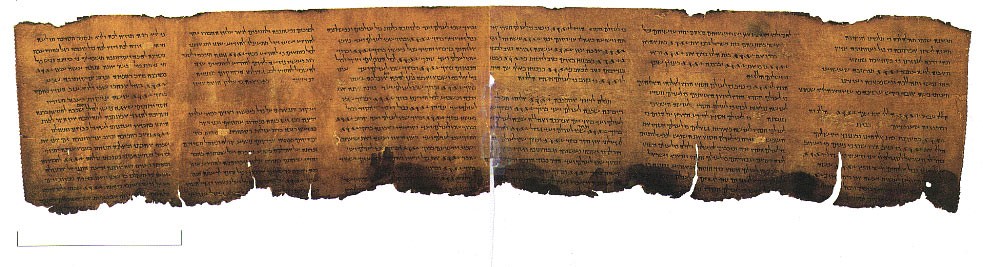
The Psalms Scroll (11Q5) from the Dead Sea Scrolls find.
Prior to the discovery of the Dead Sea Scrolls the earliest manuscripts of the Old Testament were from around 1000AD. When the scrolls were brought out of the caves and examined they were found to have been from 200BC. When these texts were compared to the texts from 1000AD they were found to be virtually identical.
That’s 1200 years of history without any significant changes to the text.
The scrolls contained the entire book of Isaiah along with fragments of every other book of the Old Testament, except the Book of Esther. This find shows that Jews and Christians from 200BC to 1000AD who may well have at some point felt tempted to make alterations to the text for their own gains – particularly when facing the threat of persecution – stayed true to what was written before and left the texts intact, faithfully transmitting them on for future generations.
Assembling the New Testament
To conclude this part of the series, let’s look at the historical record of the complete works of the New Testament.
- The John Rylands manuscript from 130AD has portions of the Gospel of John
- The Bodmer Papyrus II (150-200AD) has most of the Gospel of John
- The Chester Beatty Papyri (200AD) has major portions of the New Testament
- The Diatessaron (160AD) has all four gospels (Matthew, Mark, Luke, and John)
- The Codex Vaticanus (325-350AD) has nearly all of the Bible
- The Codex Sinaiticus (350AD) has all of the New Testament and half of the Old Testament
We have copies of the entire New Testament just 300 years after the first parts were being written with further fragments dating back to within 80 years of the original text.
When we pick up a copy of the New Testament today, we can say with historical authority and conviction, that the words we hold in our hands are overwhelmingly likely to be what the authors originally wrote. They haven’t been changed, deleted, or expanded upon. They are what was written down, they are what the authors intended to communicate.
In Part III of this series we’re going to look at whether we can actually trust the authors. We’re going to ask if eyewitness testimony is credible. And we’re going to look at what other writings from the historical record say about this time. After all, the events surrounding Jerusalem a couple of millennia ago have left a huge mark on history. Surely others must have made note of this? More on that, in Part III.
The Bible – Part I

For Christians the Bible is the central text of our faith. It is the book. As meticulously studied by scholars as it is treasured by Christ’s followers, it has comforted, challenged, provoked, and outraged countless people over thousands of years. Oft quoted and ever paraphrased, and yet faithfully transmitted, translated, printed and distributed – and hugely accessible in large parts of the world.
Presidents are sworn in with one hand on a copy of the Bible. University entrances are emblazoned with verses taken from it. It has instigated political reform, challenged Kings and Emperors, outlived entire civilisations and transcended cultures.
The Bible has been the chosen foundation for living well – both for individuals and for nations. Through its pages we learn of a history of God’s interaction with humanity. We learn of the promise of redemption and read how it happened through the person of Jesus Christ.
New Series
Today we’re starting a new series on the Demolition Squad blog. The purpose of this series is to look at some of the basic facts of the Bible, to examine the text, the composition, and the history of transmission. We will evaluate the trustworthiness of what is says within the pages of this bestseller. Christianity doesn’t teach that we ought to simply believe for belief’s sake, without reasons, without evidence. We don’t believe in a vacuum. Christianity isn’t a blind leap of faith, but a commitment to following the evidence where it leads.
The sacred texts of the Christian faith are there to read, to examine, and to prod around in. They are holy not because they forbid examination, but demonstrate their holiness through the repeated tests that have been devised for it.
As the central text of the Christian faith the Bible is hugely important. So it’s important that we understand it. There are many opinions of what the Bible is and how it got to us today. For example, here’s one of them:
“To be fair, much of the Bible is not systematically evil but just plain weird, as you would expect of a chaotically cobbled-together anthology of disjointed documents, composed, revised, translated, distorted and ‘improved’ by hundreds of anonymous authors, editors and copyists, unknown to us and mostly unknown to each other, spanning nine centuries.”
Richard Dawkins
If Richard Dawkins is right, then Christians have some serious problems. For if we cannot trust the history of the Bible, how can we trust what it claims? And if we cannot trust the claims of the Bible, then our basis for faith has been dealt a major blow. The Bible is an evidence of the Christian faith and one that many of its truths hang upon. If this evidence is dismissed, many things will be lost.
It would be not possible to have the Christianity we know without the Bible as the Bible. When we lose the Bible, we lose Christianity.
Core Bible Facts
To start us of we’ll take a look at the basic facts of this great book.
1. The Bible contains 66 books
In this way the Bible is like a library of books – 39 in the Old Testament, and 27 in the New Testament.
2. The Bible was written over a roughly-1,500 year period
From the oldest parts of the Old Testament to the most recent parts of the New, the span from beginning to end is a whopping 1,500 years. This is a long time. 1,500 years ago in England the Britons were fighting the Anglo-Saxons and King Arthur was supposedly running around.
In the Ancient World, this span of time contained the Egyptian, Greek, and Roman empires.
3. The Bible was written in three different languages
The languages of the Bible are Hebrew (most of the Old Testament), Aramaic (some of the Old Testament), and Greek (the New Testament).
Hebrew and Aramaic were common languages for the ancient Israelites during the period in which the Old Testament was being written.
By the time of the New Testament, Alexander had conquered many parts of northern-Mediterranean Europe and had enforced the use of the Koine Greek language throughout. The Romans, after taking over the Greek Empire, continued to use this language alongside their Latin and trained their scholars in it. As such, it was commonly spoken and written throughout the Roman Empire, including the geographical areas and timespan of the New Testament.
4. The Bible was written by around 40 different authors
These authors were from all walks of life too. From Kings, to peasants, to doctors, to missionaries.
5. The Bible has one main theme: God’s redemption of man
Starting with the book of Genesis and ending with the book of Revelation the Bible speaks of a history of God’s involvement with his people.
The Old Testament tells of a beautiful world, disrupted by sin, and a promise from God to restore the world to perfection once again. Along the way we see acts of heroism and acts of tragedy. Many people trust in God, and equally many people turn their back on him. There is great hope and there is great depravity.
The New Testament shows the promises of the Old Testament fulfilled in the person and work of Jesus Christ. It builds open the Old Testament and sits on the foundation of the 39 books that came before it.
6. The Bible has one main character: Jesus
Historical records, poems, letters, and wisdom literature – in the Bible there are lots of words written by many people about many things yet when we step back and survey the complete works as a whole we see a story line that’s built around one person: Jesus Christ. The Old Testament prophesies and points towards his arrival, and the New Testament tells of the prophecies come true.
These 6 facts sum up quickly what the Bible is. Next we need to show whether any of the above matter, to ascertain whether or not we can trust what is written in our Bibles.
Road Map
Here’s a roadmap for where we’re going. Over the next few weeks we will look at:
- How well or poorly the Bible has been transmitted throughout history
- How reliable we find the text to be – both when tested against what it says elsewhere within it, and against external material
- What the legacy of the Bible throughout history has been
A Word on Comments
We love to engage in comments on the Demolition Squad blog and hope that healthy debate springs up around what is written here. We will look to deal with comments as they come up. It may be that a question that is raised after one part of this series will be answered later on. In that case we’ll most likely reply stating that your point will be covered later.
We’ve also reserved the last article of the series to answer any larger questions that come up over the course of all the articles, that we think requires more space to deal with.
Series
Good Friday, Death Friday
Good Friday. The day of Jesus’ death. The day an innocent man received an unjust sentence and a guilty man got off scot-free. The day a man lost his friends, his family, and his dignity. I wonder who on that day would have imagined it would ever come to be revered, to be called ‘good’.
Of course, we see the whole event as those looking back on one day out of one weekend in one man’s life. Friday led to Saturday and Saturday to Easter Sunday. Perhaps the disciples were crushed by the moment, but the moment passed. The story of Easter, of a saviour come to rescue his people, his creation – in love – is a collection of moments, one after the other.
That Friday – Death Friday – a tribe and a city were rocked, temporarily masking the true death that day, that of death itself. When Jesus left the tomb on the Sunday and appeared to his friends and disciples, the crushing moment that was Friday was rearranged, reinterpreted, recast into the story that would compel them to leave their homes and tell it to the world. The Good Teacher had died and through his death his goodness became accessible to everyone. On that Friday the worst of us and the rest of us could be made Good.
Life comes to us in moments but is weaved together into a story. Jesus’ life is a collection of moments, points in history that happened. These moments surprised, excited, confused, scared, and angered people. And when we look at these moments in history we see the grand story rise out from them. It is a story both predating those moments and also yet unfinished.
The story of Easter is Good News. It is our gospel. We are a part of it, and we are a messenger for it. Life’s moments may temporarily obscure our view of our story and, ultimately, his story. But yet, his story remains. On Easter Sunday – A Ha! Sunday – the story swallowed up the moment. Uncertainty gave way to clarity; despair acceded to hope. The promise in the narrative is that our moments will never swamp our story. Jesus’ death and resurrection will always give us hope. Our story will be forever caught up in His story, and that story is worth talking about.
Good Friday. The day of Jesus’ death. The day a guilty man got off scot-free whilst an innocent man stood in my place. The day I was handed my friends, my family, and my dignity. Who, I wonder, could imagine a more apt name for it?
Further Demolition Squad Blogs on Easter
God's Not Dead
Is God dead? Not in academia. As someone who teaches philosophy at Wycliffe Hall, University of Oxford, Vince Vitale is well placed to know what the top scholarship says about God.
Vince shows how in the fields of philosophy and sociology, God is very much alive. If you think intellectual objections undermine belief in God, Vince suggests that you may be unaware of the arguments at the highest level.
Beer Mat Apologetics
The Demolition Squad seminar from The Gathering – 2013.
tg13: Demolition Squad seminar from CVM on Vimeo.
5 Principles of Sharing Your Faith
Beer Mat Apologetics is the stuff we do with our friends, in the pub, when we’re talking about Jesus. Yes, every man is an expert, and yes, we all have opinions about everything.
Into this arena we want to present Jesus well. Christianity – as a faith – makes sense emotionally and rationally and we can communicate it on both of these levels.
Check out the blog post ‘Beer Mat Apologetics: Five Principles of Sharing our Faith‘ for five principles to help you share your faith more effectively with your friends, family, and colleagues.
The Gathering 2014

Bookings are now open for The Gathering 2014. It’s bigger and better than last year and features great speakers and lots of fun!
Mark the 20-22 June on your calendar and invite your friends. It’s going to be great!
